
At some point, many caregivers end up doing the same thing. You open a dozen tabs late at night, search for disability grants, click through government pages, and come away with more questions than answers. One site talks about housing repair. Another talks about benefits. A third looks like a grant but turns out to be a loan, a voucher, or a tax credit.
That confusion is normal. The phrase American disabilities grants sounds like it should describe one clear program. It doesn't. It covers a patchwork of programs, agencies, eligibility rules, and funding types that often make sense only after you know how the system is organized.
The good news is that you do not need to understand everything at once. What works is a structured search. You start by defining the need, match that need to the right kind of help, and then build an application file you can reuse. That approach saves time, cuts down on dead ends, and helps families focus on programs they can qualify for.
Starting Your Search for Financial Support
A typical starting point looks like this: your parent needs a safer bathroom, your spouse needs transportation help, or your adult child needs support services, and the bills are getting ahead of you. You search “grants for disabled people” and find lists that mix federal benefits, nonprofit aid, home repair programs, and school resources as if they all work the same way.
They don't.
The first practical move is to stop searching for “money” in the abstract and name the exact problem. Is it home access? Vehicle modification? Medical equipment? Caregiver respite? Employment support? Education? Legal advocacy? The narrower your question, the better your results.
Practical rule: Search by need + life situation, not by the word “grant” alone.
A caregiver helping an older homeowner stay in the house should search differently from a parent looking for developmental disability services or a veteran family adapting a home after an injury. The funding source, paperwork, and timeline may be completely different.
Start with a one-page note that lists these five items:
- Who needs help: Include age, diagnosis or functional limitation, and whether the person is the applicant or dependent.
- What the money is for: Be specific, such as wheelchair ramp, respite care, communication device, or bathroom modification.
- Where the person lives: State, county, and whether they rent or own.
- What systems are already involved: Medicaid, VA, school district, vocational rehabilitation, or Social Security.
- What the deadline is: Urgent safety need, routine replacement, or long-term planning.
That short list becomes your filter. It helps you avoid spending hours on programs that were never a fit.
Understanding the Disability Grant Landscape
Many might imagine one big pot of federal money waiting to be claimed. In practice, disability funding works more like multiple streams feeding a river. Federal programs, state agencies, local offices, and nonprofits all contribute, but they do it in different ways and for different reasons.
One reason families get frustrated is that most public disability support does not show up as a simple direct cash grant. For intellectual and developmental disabilities, public funding in FY2021 was about $80.6 billion, and 87% of that flowed through Medicaid services, which means support is largely tied to healthcare-linked systems rather than small standalone grants, according to the University of Kansas overview of IDD funding.
The four places families usually find help
Federal programs tend to be the first place people look. They can be substantial, but they are often tightly defined and slower to get through.
State programs are where many practical supports get routed. States administer a lot of disability-related services through Medicaid, vocational rehabilitation, developmental disability systems, and housing or transportation offices.
Local programs may be small, but they can be easier to access. County aging offices, Centers for Independent Living, local transit programs, and city housing departments often know what is active in your area.
Nonprofit programs are usually narrower and more targeted. That can be a strength. A disease-specific foundation or community service club may fund exactly the piece a public program won't cover.
If you're also sorting out baseline income support, it helps to understand how cash disability benefits differ from grant programs. This plain-language guide from Melanson Law Group on the difference between SSI and SSDI is useful because many families mix those systems together at first.
Income rules also shape eligibility across many programs. Keeping a current federal poverty level chart handy can make screening much faster.
Types of Financial Aid for Disabilities
| Aid Type | What It Is | Best For | Key Consideration |
|---|---|---|---|
| Grant | Funds that generally do not need repayment | Home modifications, assistive needs, caregiver support, targeted projects | Usually limited by strict eligibility and purpose |
| Loan | Borrowed funds, sometimes favorable terms | Larger repairs or urgent modifications when grant funds fall short | Repayment still matters, even if terms are better |
| Voucher or service authorization | Approval for a specific service or item | Transportation, respite, equipment, support services | Often can't be used flexibly outside the approved category |
| Tax credit | Reduction in tax liability for qualifying expenses | Accessibility improvements, especially for businesses | You usually pay first, then claim the benefit if eligible |
The best search question is often not “What grants exist?” It's “What kind of aid fits this exact expense?”
How to Find Federal Disability Grants
Federal help is real, but it rarely works as an all-purpose relief fund. The fastest way to waste time is to search broad portals without a target. The fastest way to get traction is to start with the need, then identify the agency or program family most likely to fund it.
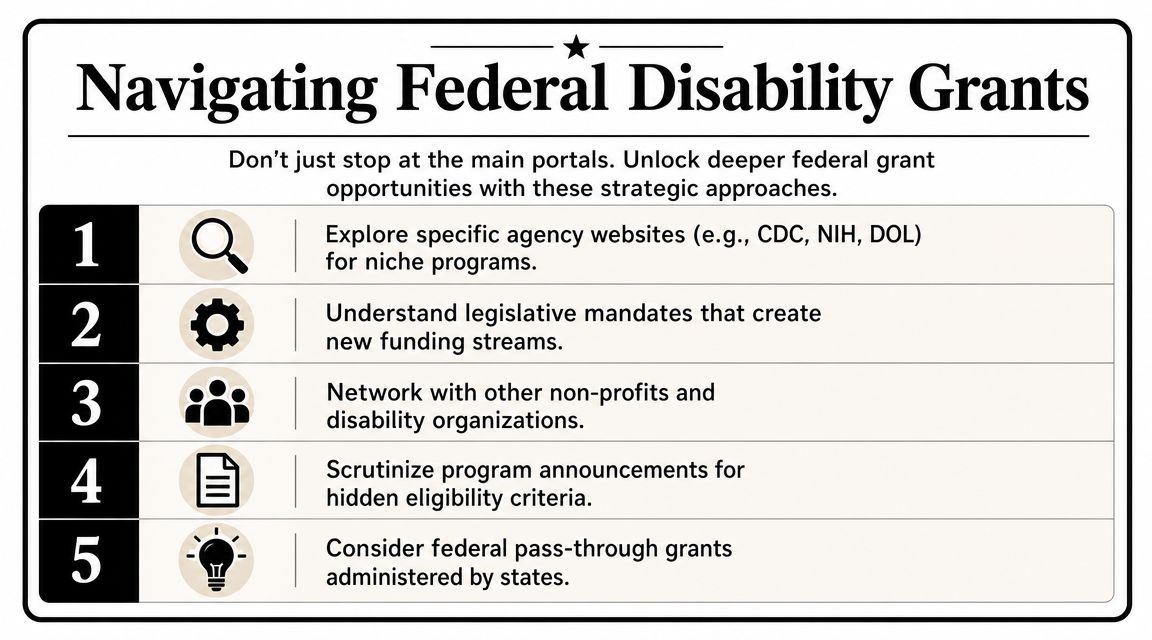
Use federal portals as indexes, not answers
Sites like Grants.gov and Benefits.gov can help, but they work best when you treat them as directories. Search terms such as “home modification,” “assistive technology,” “caregiver support,” “independent living,” “veteran housing,” or “transportation accessibility” will usually get you further than “disability grant.”
Try building searches around these combinations:
- Need plus agency: “wheelchair ramp HUD,” “home repair USDA disability,” “adaptive housing VA”
- Need plus role: “caregiver respite federal program,” “disabled adult employment assistance”
- Need plus setting: “rural disability transportation funding,” “homeowner accessibility assistance”
Read the eligibility section before anything else. Don't start the application first. Many programs are designed for organizations, pass-through agencies, or specific categories of applicants rather than individuals.
Housing aid is where many searches go off track
A major source of confusion is housing. Families often ask for a general disability housing grant, but the options are more specific. Federal choices such as HUD's Section 504 program, USDA housing repair loans or grants, and VA home grants depend on factors like income, age, location, homeownership, and veteran status, as explained in this overview of housing-related grants for people with disabilities.
That means the practical question is not “Where's the disability housing grant?” It's “Which program matches this household's facts?”
A quick example helps. If a retired homeowner needs a ramp, the right starting point might be a housing repair program tied to income and ownership. If the household rents, that same search path may fail entirely, and you may need to shift toward landlord coordination, local accessibility programs, or nonprofit support.
Watch for programs connected to benefits
Some federal systems don't look like grants at first, but they shape what help becomes available. If the person you care for may qualify for disability income, understanding program rules early can help you avoid contradictory applications and missed documents. This overview on understanding SSDI eligibility is a useful reference when Social Security may be part of the larger plan.
A strong federal search starts with the applicant's facts. Age, veteran status, household income, ownership status, and location usually matter as much as the disability itself.
A workable federal search routine
Use a repeatable method:
- Write one sentence defining the expense. Example: “My father needs a bathroom modification to reduce fall risk.”
- List the life-situation filters. Homeowner or renter, veteran or not, age, income, state.
- Search the likely agencies first. Housing, veterans, agriculture, labor, education, transportation.
- Reject poor-fit programs quickly. If the applicant category is wrong, move on.
- Save only live leads. Keep a spreadsheet with contact name, deadline, documents needed, and next step.
Families often make progress once they stop treating federal funding as one mystery box and start treating it as a map of specialized doors.
Tapping Into State and Local Funding Sources
State and local funding is often where a stalled search starts moving. These programs are closer to the person's daily life, and the staff usually understand local service gaps, contractor realities, and what's available this year.
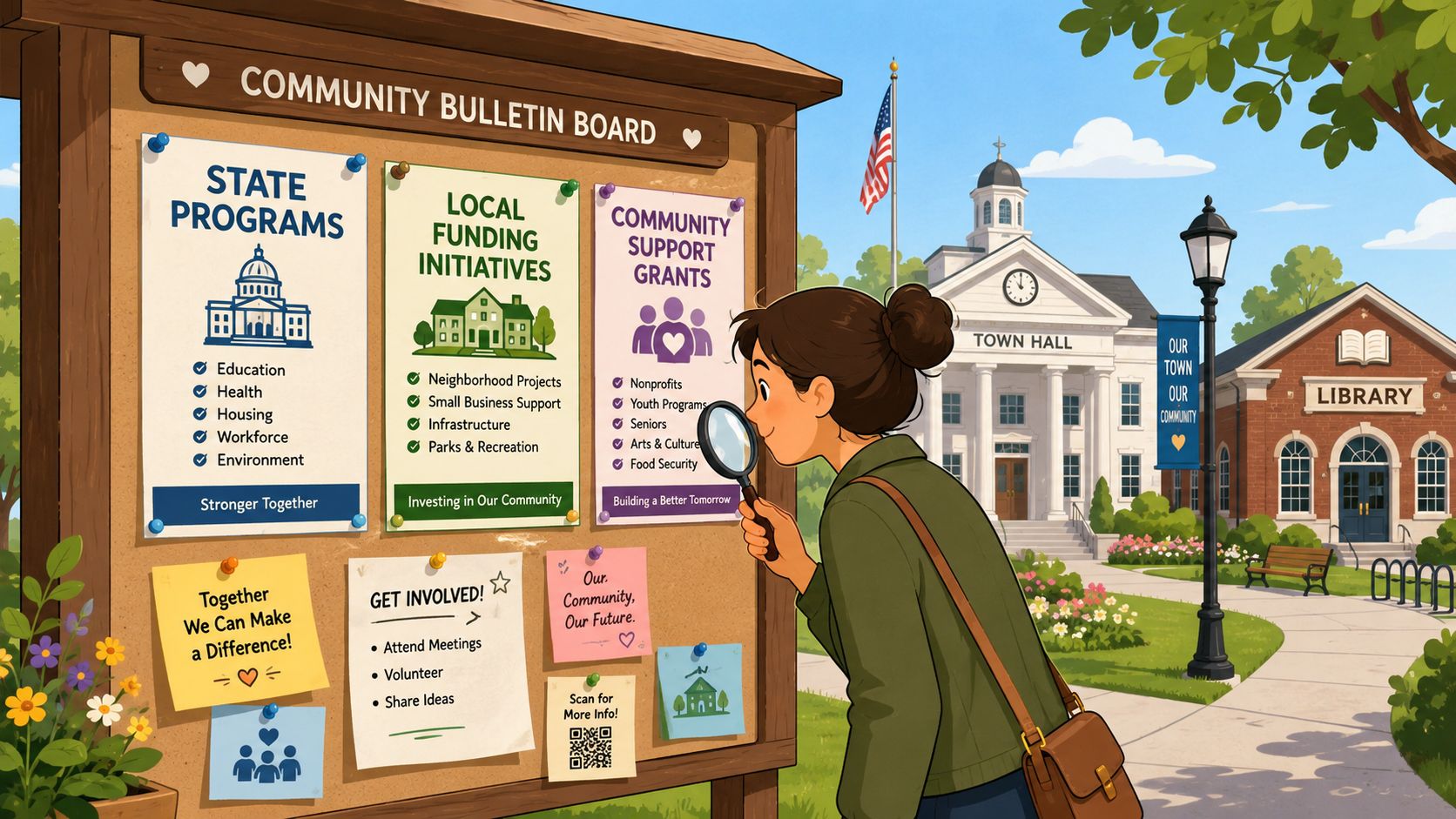
Start with agencies that already touch disability services
If you only call one office, don't make it a random grant hotline. Call the agency most connected to the person's actual need.
Good starting points include:
- State Vocational Rehabilitation agency: Useful for employment-related supports, training, and some equipment tied to work goals.
- Area Agency on Aging: Often a strong entry point for older adults and caregiver support.
- Center for Independent Living: Helpful for accessibility barriers, independent living planning, and local resource knowledge.
- Council on Developmental Disabilities or related state office: Worth checking when the person has lifelong developmental support needs.
- County social services or aging office: Often knows local emergency funds, home repair partners, or respite options.
If Medicaid is part of the picture, keep your income documentation ready. Families often need current financial information when screening for state-administered help. This guide to Medicaid income limits can help you organize the right questions before you call.
A local example that reflects what works
Suppose a caregiver needs a wheelchair ramp for an older parent. A federal portal search may produce broad results with long eligibility screens. A better route might be local.
Call the Area Agency on Aging and ask whether they know of home-accessibility funding, contractor referral lists, or nonprofit partners. Then call the local Center for Independent Living and ask whether they know of ramp programs, volunteer build projects, or county accessibility funds. If the person is also enrolled in a state disability service system, contact that case manager the same day.
That sequence works because local offices often know how to piece together support. One may know a small grant. Another may know a loan fund. A third may know a church or service club that fills the final gap.
Accessibility advocacy matters at the local level
State and city governments also handle pass-through money for transportation and public-service projects. The U.S. Department of Transportation states that the ADA and Section 504 apply to all federally funded transportation projects, including public involvement and design requirements, in its guidance on incorporating accessibility into transportation projects.
That matters for caregivers because you can push for practical improvements close to home. If a bus stop lacks accessible access, a public meeting is held in an inaccessible space, or local project materials are not usable, those are not minor inconveniences. They may be issues the project sponsor is required to address.
When a caregiver speaks at a local meeting about curb cuts, bus access, or accessible meeting materials, that is not outside the grant process. It can shape how funded projects get built.
What to ask when you call
Don't ask only, “Do you have grants?” Ask:
- What programs help with this type of need locally?
- Who decides eligibility?
- Is there a waitlist or funding cycle?
- Are there partner nonprofits or pass-through funds?
- What documents should I gather before applying?
That last question saves time. A prepared caller usually gets more useful answers than someone searching in general terms.
Exploring Non-Profit Grants and Other Financial Tools
Nonprofit funding usually won't solve everything at once. It can still be the piece that makes a plan work. In real caregiving situations, families often succeed by combining several tools rather than waiting for one perfect award.
Where nonprofit money tends to be most useful
Disease-specific foundations can be a good fit when the need closely ties to a diagnosis. Community foundations may support local hardship or accessibility efforts. Service organizations such as Lions clubs, faith communities, and civic groups sometimes help with vision-related equipment, small home changes, transportation, or emergency needs.
These sources are often easier to approach when you have a narrow ask. “We need help paying for a portable ramp” is stronger than “We need financial assistance.”
Another useful category is caregiver-focused support. If the person you care for is older, this roundup of grants for senior citizens can help you identify adjacent programs that families often miss when they search only under disability terms.
Don't ignore tax tools and partial funding
Some families need accessibility changes for a small business they own or operate. In that setting, the most direct federal help may not be a grant at all. The Disabled Access Credit allows eligible small businesses to claim 50% of eligible access expenditures above $250 and up to $10,250 of annual qualifying costs, for a maximum credit of $5,000 per year, according to this explanation of the Disabled Access Credit for ADA compliance.
That structure changes planning. If a business has several accessibility projects, it may make sense to phase them instead of assuming every dollar will qualify in the same way.
Build a layered funding plan
Here's what a realistic package can look like:
- A small nonprofit grant for a specific device or modification
- A local civic donation for part of the labor or installation
- A state service authorization for related support
- A tax credit where the expense qualifies
- Family funds or a modest loan to cover the remainder
That layered approach is more common than people expect.
One practical tool that can help families keep all of this straight is a paper or digital organizer. Family Caregiving Kit offers worksheets and decision tools that can be used to track contacts, compare programs, and collect application details in one place. That kind of system matters because mixed funding plans fall apart when nobody can find the paperwork.
The strongest funding plans are built, not found. Families piece them together one source at a time.
Your Step-by-Step Grant Application Strategy
A good application is rarely about writing flair. It's about fit, clarity, and organization. Because discretionary disability funding is limited, preparation matters. A policy analysis noted that discretionary federal programs for disability support received about $29.8 billion in FY2024, which underscores why weak or incomplete applications struggle in a competitive pool, as discussed in New America's analysis of disability funding.
Begin with a system you can reuse.
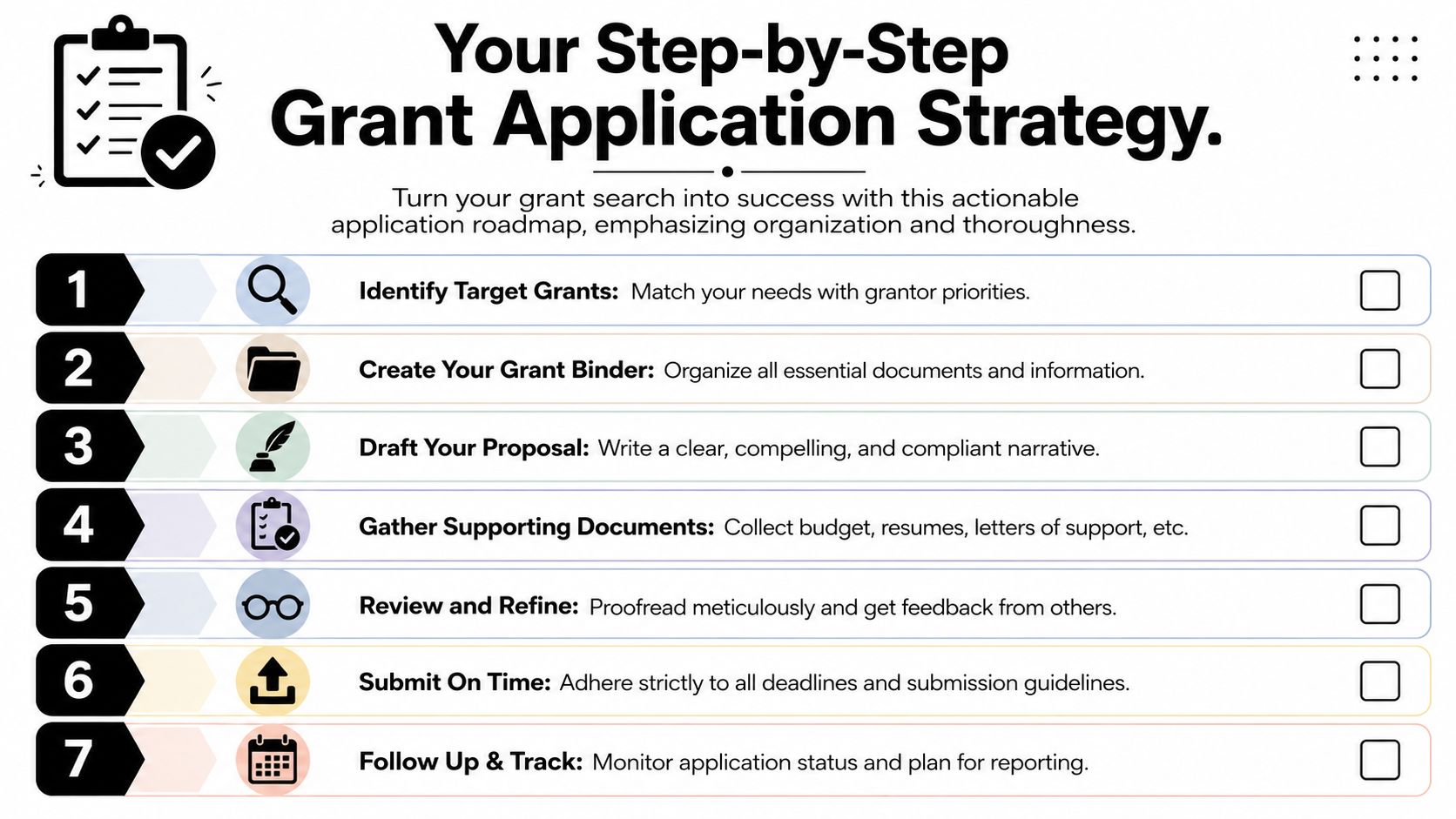
Build a grant binder before you apply
Your grant binder can be a physical folder, cloud folder, or both. It should hold the documents you'll need again and again:
- Identity documents: ID, Social Security-related paperwork if relevant, proof of address
- Medical documentation: Diagnosis, prescriptions, therapist or physician letters, functional limitations
- Financial records: Income documents, benefit letters, tax records if required
- Housing records: Lease, mortgage statement, property tax record, contractor estimates
- Support statements: Caregiver letter, case manager note, photos of the barrier or need
If you're applying for a bathroom modification, include photos, a simple written description of the current safety risk, and one estimate that clearly names the accessibility work. Reviewers respond better to a specific problem than a vague hardship statement.
Write for decision-makers, not for sympathy alone
This short video is a useful reminder that strong applications are built on process, not panic.
The narrative should answer four questions:
What is the problem?
Example: the current bathroom setup creates fall risk and limits safe transfers.Why does this applicant qualify?
Tie the need directly to the program's stated priorities.What will the funds pay for?
Be concrete. Grab bars, roll-in shower adaptation, widened doorway, ramp materials.What changes if funding is approved?
Safer transfers, easier caregiving, improved access, reduced barriers to daily life.
Avoid dramatic language that doesn't add facts. Specificity is more persuasive.
Application test: If a reviewer can't tell exactly what the money will buy, the request is not ready.
Vet programs before you submit
Not every listing is trustworthy or useful. Before applying, check:
- Who runs the program: Government agency, recognized nonprofit, or community foundation
- What the eligibility rules say: Read them yourself
- Whether the application asks for fees: Legitimate grant applications should not depend on pay-to-apply promises
- Whether the timeline is real: Open date, deadline, and decision process should be clear
- Whether the award purpose matches your need: Close enough often is not enough
A practical submission routine
Use a simple checklist for every application:
- Save the announcement
- Highlight required attachments
- Draft answers in a separate document first
- Have one other person review for missing items
- Submit early when possible
- Store the confirmation email or screenshot
- Set a calendar reminder for follow-up
Families who do this once can reuse the system across multiple programs without starting from scratch each time.
Common Questions About Disability Grants
Can disability grants pay general living expenses
Usually, not in the broad way families hope. Many grants are restricted to a specific purpose such as equipment, modification, transport, or respite. If monthly income is the primary concern, you may need to look at benefit programs rather than grants.
How do I avoid grant scams
Be cautious with any program that promises guaranteed approval, asks for upfront fees, or stays vague about who runs it. Real programs may be bureaucratic, but they usually provide a clear sponsor, eligibility rules, and a defined use for funds.
What if a disability benefit application was denied
That happens often enough that families should be prepared for it. If Social Security is part of your plan, it helps to understand common denial reasons before reapplying or appealing. This guide on understanding disability benefit rejections can help you spot weak points in the file.
Are there grants just for caregivers
Sometimes, but they are usually indirect. Caregivers often find support through respite programs, aging services, diagnosis-specific nonprofits, and local family support programs rather than a grant labeled only for caregivers.
Should I apply to everything I find
No. Apply to the programs that fit the facts. A smaller, well-matched application usually beats a stack of rushed submissions to poor-fit programs.
If you want a practical way to stay organized while comparing programs, tracking calls, and gathering documents, Family Caregiving Kit offers tools and guides built for families managing real caregiving decisions. It's a useful next step if you're trying to turn a scattered search into a workable plan.