
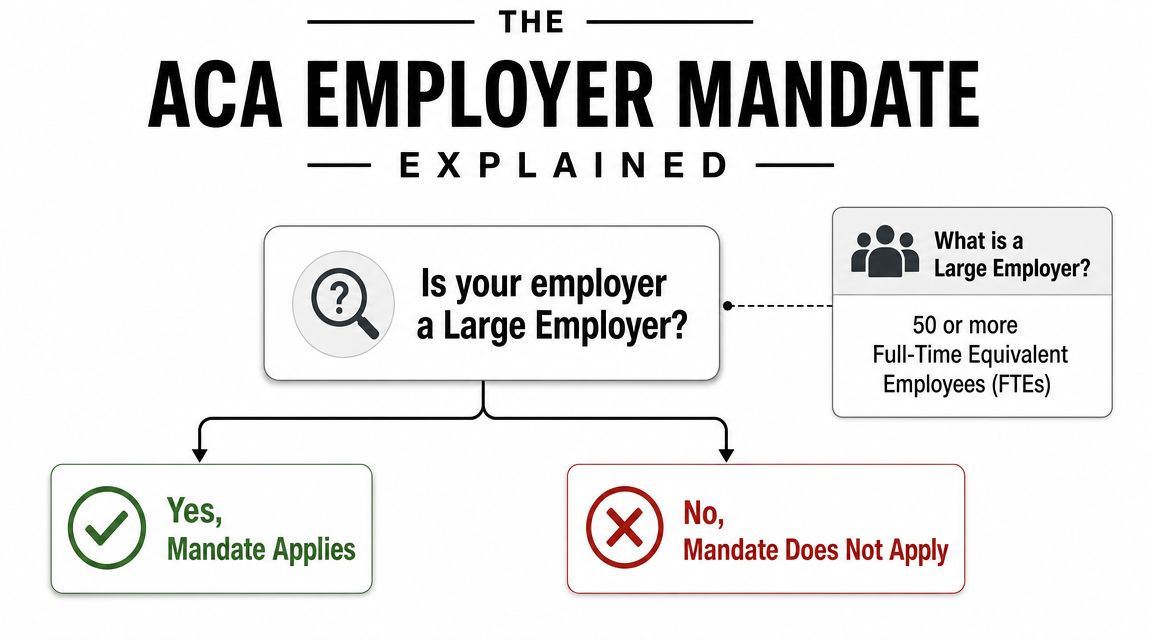
In the U.S., employers aren't universally required to provide health insurance. The main federal rule is that employers with at least 50 full-time equivalent employees generally must offer affordable, minimum-value coverage to at least 95% of full-time employees and their dependent children up to age 26, or face penalties.
That answer sounds simple until caregiving changes your work life.
You may have just cut back your schedule to help a parent after a hospital stay. Or maybe you're trying to keep your job while driving to appointments, managing medications, and answering calls from home health aides. In that moment, the question usually isn't just, “Are employers required to provide health insurance?” It's, “Am I about to lose the coverage my family depends on?”
That fear is understandable. Employer coverage is a major part of how families get care in the first place. Employer-sponsored health insurance is the largest source of coverage for people under 65, with KFF estimating about 154 million people covered this way in its 2023 Employer Health Benefits Survey.
Understanding Your Health Insurance Rights at Work
A lot of caregivers think this is a yes-or-no legal question. It usually isn't.
Take a common situation. You work for a company with decent benefits. Then your dad needs more help, so you ask to move from a full schedule to something lighter. Your boss agrees. You feel relief for about a day, and then the next thought hits: “If I'm working fewer hours, do I still get health insurance?”
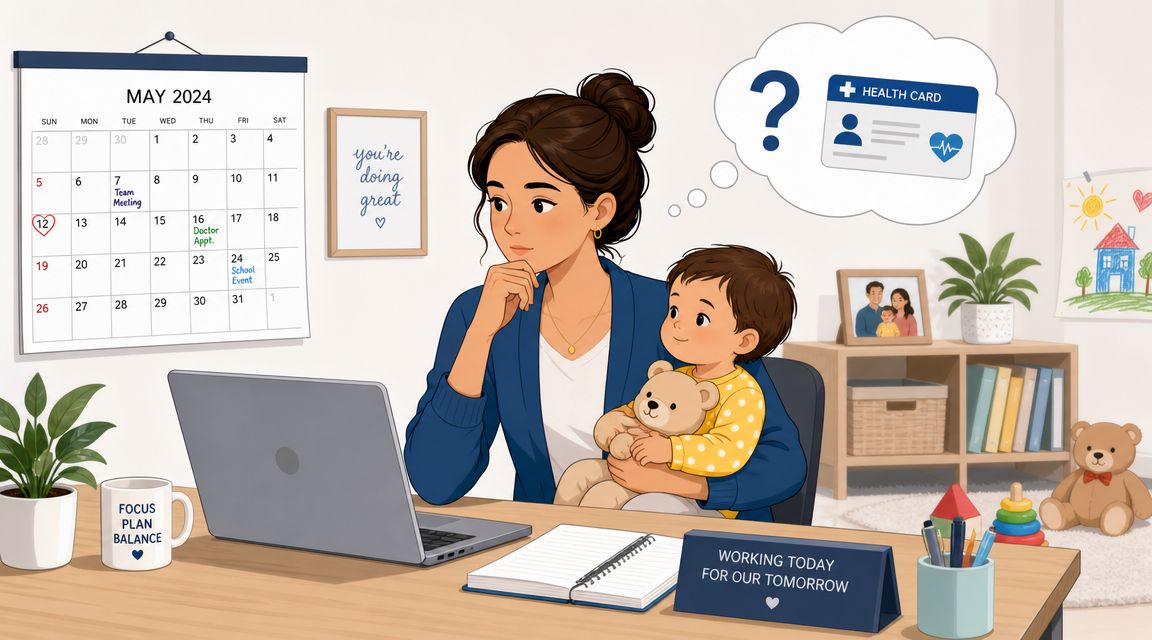
That's where people get tripped up. There are really two separate questions:
- Does your employer have to offer coverage at all? That depends largely on employer size under federal law.
- Do you still qualify for the plan your employer offers? That often depends on your work hours and plan eligibility rules.
Why caregivers often feel blindsided
Caregiving rarely changes just one thing. It changes your schedule, your energy, your income, and sometimes your job type all at once. Someone who was a full-time employee in January may be part-time by spring, on leave by summer, or piecing together freelance work by fall.
Practical rule: Don't assume your company's general benefits policy answers your personal eligibility question. Your status, hours, and leave situation matter.
This is why broad internet answers can feel frustrating. They might explain the 50 full-time equivalent employee rule, but they skip the part that matters to your household this week. If your hours changed, if you moved into a variable schedule, or if you're taking leave, the practical answer can shift fast.
What this means for you right now
Start by grounding yourself in one fact. A company's legal obligation to offer insurance and your own right to stay enrolled are related, but they are not the same thing.
If you're under pressure and need a starting point, focus on these three questions:
- How large is my employer?
- Am I still considered full-time for benefits purposes?
- If coverage ends, what's my backup option immediately?
Those questions turn panic into a checklist. That's the most useful way to approach this when you're already stretched thin.
The Federal Rule The ACA Employer Mandate Explained
The core federal rule comes from the Affordable Care Act. Under the ACA, employers with at least 50 full-time equivalent employees generally must offer affordable, minimum-value coverage to at least 95% of their full-time employees and their dependent children up to age 26, or face penalties, as explained in Cigna's overview of the ACA employer mandate.
What full-time equivalent really means
The wording becomes awkward here. Full-time equivalent employees, often shortened to FTEs, does not just mean “50 people on payroll.”
A better way to think about it is this: the law looks at a company's workforce in full-time units. If several part-time employees together work the equivalent of full-time schedules, those hours can count toward the total.
For a caregiver, that matters because a business that looks “small” on the surface may still be large enough under the ACA for the mandate to apply.
Two half-time workers can add up to one full-time equivalent for this purpose. So employer size is not always obvious from a quick headcount.
What the employer must offer
The mandate isn't just about offering any plan with an insurance card. The coverage generally has to meet two standards:
- Affordable coverage means the employee share of the cost must stay within ACA standards.
- Minimum value means the plan has to provide a meaningful level of coverage, not just bare-bones access.
You don't need to memorize the legal language. The practical point is that a large employer can't usually satisfy the rule by offering coverage that is too skimpy or too expensive for eligible full-time employees.
Who must be offered coverage
The ACA rule focuses on full-time employees. In this context, full-time generally means averaging 30 or more hours per week. The offer also has to extend to dependent children up to age 26. It does not require employers to cover spouses.
That spouse point surprises people all the time. A reader may think, “If my employer has to offer family coverage, my husband or wife must be included.” Not necessarily. The federal structure is more limited than many families assume.
Here's a plain-language way to sort it out:
| Question | Federal rule in plain English |
|---|---|
| Is every employer required to offer insurance? | No |
| Which employers are usually covered by the mandate? | Those with at least 50 full-time equivalent employees |
| Who counts as full-time? | Employees averaging 30 or more hours per week |
| Who must be included if coverage is offered under the mandate? | Full-time employees and dependent children up to age 26 |
| Are spouses required to be covered? | No |
For caregivers, the biggest takeaway is simple. If your employer is large enough, federal law may require an offer of coverage. But your own eligibility still depends on whether you remain in the category the plan covers.
What Happens with Small Employers (Fewer Than 50 Employees)
If you work for a smaller employer, the answer is usually different. The U.S. Department of Health and Human Services says that businesses with fewer than 50 full-time employees and FTEs are not required by the ACA to offer health insurance, though they may be eligible for the Small Business Health Options Program (SHOP).
That can feel unfair when you need coverage and your employer doesn't offer it. But it helps to know this usually isn't your employer singling you out. Many small businesses aren't under the federal penalty system that applies to larger employers.
If a small employer does offer coverage
A small business can still choose to provide health benefits. Some do it to support retention, simplify hiring, or stay competitive in their local market. Others can't absorb the cost or administrative burden.
If your employer is trying to build a plan from scratch, a practical overview of developing small business benefits strategy can help explain why smaller companies make different tradeoffs than large employers.
What this means for caregivers
This part matters emotionally as much as legally. When you're balancing work and family care, it's easy to take a missing benefit personally. But in many cases, a small employer's lack of coverage reflects company size and budget, not your value.
A useful way to approach the conversation with HR or an owner is:
- Ask directly about current offerings: Is there a group plan, reimbursement arrangement, or access path the company already uses?
- Clarify eligibility rules: If a plan exists, who qualifies for it and after what waiting period?
- Check whether hours matter: Some small employers offer benefits only to employees working a set schedule.
- Request plan documents in writing: Verbal answers often leave out important details.
If a small employer offers insurance, you still need the plan's actual eligibility rules. “We have benefits” doesn't tell you whether you qualify after reducing your hours.
That distinction helps you avoid assumptions. A small employer may have no legal duty to offer coverage, but if it does offer a plan, you still need to know exactly how that plan works for someone whose schedule changed because of caregiving.
How Job Changes for Caregiving Affect Your Insurance
This is the part most caregivers care about most. You may work for a company that offers insurance, but your coverage can still change if your job changes.
The ACA's employer mandate is tied to employees averaging 30 or more hours per week, which is why reducing your schedule can affect eligibility, as explained in this overview of employer health insurance requirements. If you drop below that threshold, you may lose access to employer-sponsored coverage even when your employer is large enough to offer it generally.
Scenario one: You cut your hours to care for a parent
Say you were working a full schedule and then moved to 25 hours a week so you could take your mother to dialysis and manage meals at home.
Your first assumption might be, “My company is large, so they have to keep me on the plan.” That's often where confusion starts. The law may require the employer to offer coverage to full-time employees, but if your average hours fall below the full-time threshold, your eligibility may change.
What you should ask HR:
- When does my new schedule affect benefits eligibility?
- Does the company use a measurement period for variable-hour employees?
- Will I keep coverage through the end of the month, plan year, or another set period?
- What notice will I receive before coverage ends?
Scenario two: Your schedule varies week to week
Some caregivers don't move cleanly from full-time to part-time. They bounce around. One week they work close to a full schedule. The next week they need time off for appointments, care coordination, or a hospital discharge.
In those situations, employers often use a method to measure hours over time for variable-hour staff. The exact process differs by employer and plan design, so you need your own company's rules in writing.
That's why a single low-hours week doesn't always mean immediate loss of coverage. But it also means a long stretch of reduced availability can eventually catch up with you.
Ask for the Summary Plan Description and the benefits eligibility policy. Those documents are usually more useful than a quick verbal answer from a manager.
Scenario three: You take leave
Leave creates a different set of questions. If you're taking approved leave, your coverage may continue for a period, but payment rules and eligibility details can become more complicated. You may need to keep paying your share of the premium while not receiving a normal paycheck.
This is also when it helps to think one step ahead. If your leave turns into a longer reduction in hours, your next move may not be employer coverage at all. If you're also sorting through options for an older relative, this guide to health insurance for elderly family members can help you separate your own job-based coverage questions from your loved one's coverage needs.
The caregiver mistake to avoid
The most common mistake is waiting until after payroll or open enrollment paperwork changes. By then, you're reacting instead of planning.
If your work life is shifting because of caregiving, ask benefits questions before the schedule change starts if you can. Even one short email to HR can give you a paper trail, a timeline, and a chance to compare backup options before coverage disappears.
Your Action Plan When Employer Coverage Is Not an Option
If employer coverage isn't available, you still have paths forward. The right one depends on your timing, household finances, and whether you need to keep the same doctors or prescriptions.
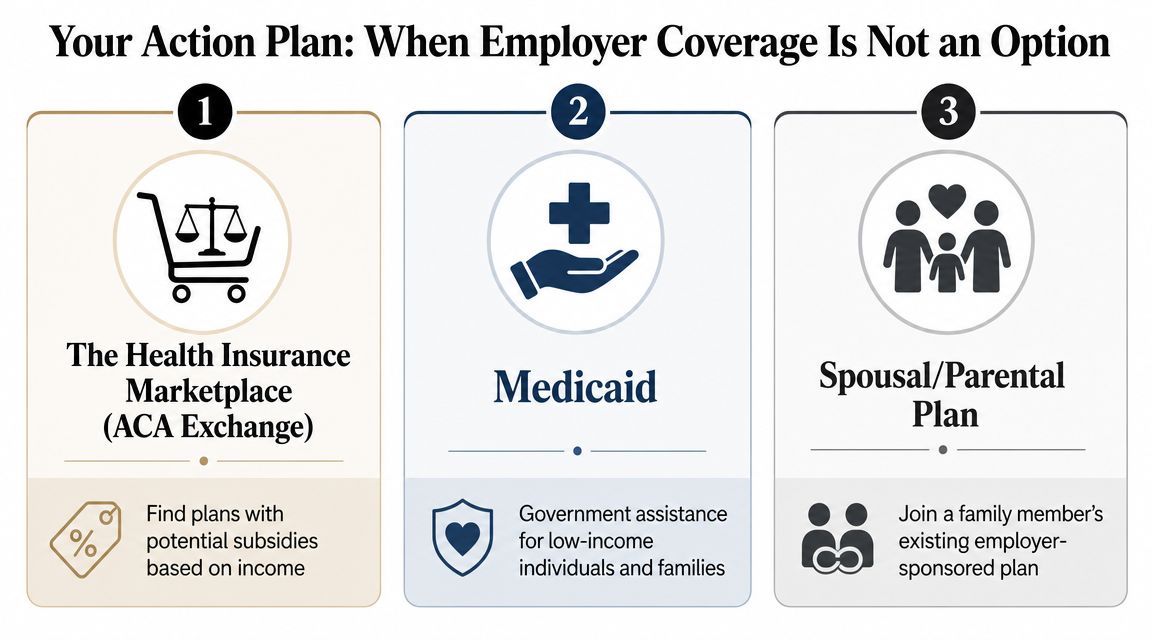
Three alternatives come up most often for caregivers: COBRA, the ACA Marketplace, and Medicaid. A fourth option can matter too if it applies to you: joining a spouse's or parent's employer plan after a qualifying life event.
A side-by-side comparison
| Option | Best when | Main advantage | Main tradeoff |
|---|---|---|---|
| COBRA | You need continuity fast | You may be able to keep the same plan and provider network | It can be expensive because you may pay the full cost |
| ACA Marketplace | You need an individual or family plan | You can compare plans and may qualify for income-based help | Provider networks and formularies may differ from your old plan |
| Medicaid | Your household income and state rules line up | It can provide low-cost or no-cost coverage | Eligibility depends on your state and circumstances |
| Spousal or parental plan | A family member has eligible employer coverage | It can be the simplest transition if the plan fits | You still need to confirm deadlines and enrollment rules |
How to choose without getting overwhelmed
COBRA is usually about continuity. If you're in ongoing treatment, managing specialist care, or trying to avoid switching plans in the middle of a family health crisis, keeping the same coverage can be worth exploring first.
Marketplace coverage is usually about flexibility. If your income changed because you reduced work for caregiving, this route may deserve a close look. If you're now freelancing or doing contract work to create a more flexible schedule, a state-focused resource like Florida health insurance for independent contractors shows the kinds of issues self-employed caregivers often need to compare.
A short video may help if you're deciding between coverage paths and trying to understand how they differ in real life.
Medicaid is usually about eligibility based on income and household circumstances. This path becomes especially important when caregiving has reduced earnings sharply or pushed someone out of employer coverage entirely.
A practical decision checklist
Use this when you're choosing among options:
- List your essential healthcare needs: Keep a written list of doctors, medications, therapies, and upcoming procedures.
- Check timing first: Ask when employer coverage ends and when a new plan could begin.
- Estimate your caregiving reality: If your schedule will stay unstable, a plan not tied to employer hours may offer more security.
- Review Medicaid early: Don't assume you won't qualify. A lower income can change the picture quickly. This guide to Medicaid income limits 2024 is a useful starting point for understanding how families often begin that review.
The best option isn't always the cheapest one on paper. For many caregivers, the real question is which plan causes the fewest disruptions while everything else is already unstable.
Checking State-Specific Rules and Taking Your Next Steps
Federal law is the starting point, not always the whole story. Some states have their own insurance rules, employer practices, continuation options, or worker protections that can change the practical answer.
That doesn't mean you need to become an amateur benefits lawyer tonight. It means you should verify the details that apply where you live and work before making assumptions.
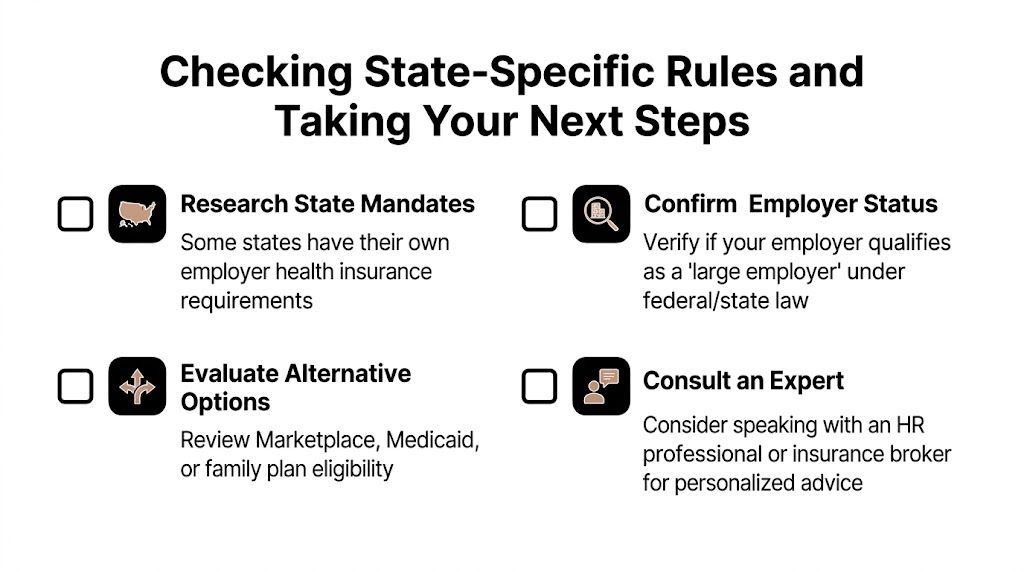
Your next-step checklist
Confirm employer size
Ask HR whether the company is treated as a large employer under ACA rules. Don't rely on guesswork based on office size or how many people you personally know.Verify your own eligibility status
Request the written rules for full-time, part-time, variable-hour, and leave-based eligibility.Pin down dates
Find out when any change to your hours affects coverage, when your current insurance ends, and what notices you'll receive.Compare backup options before you need them
Review Marketplace plans, Medicaid, COBRA, and family-plan enrollment options while you still have time to decide calmly.Use local help
If you need one-on-one guidance, a State Health Insurance Assistance Program resource can be a helpful next stop for finding counseling support.
A note for families with more complex work arrangements
Some caregivers are juggling interstate moves, remote work, contract roles, or international plans while helping a loved one. In those cases, insurance questions can overlap with broader employment and residency issues. For example, families researching flexible work abroad may also run into resources on remote work visas for Europe, which highlights how quickly work status and benefits questions can become more complicated when location changes too.
The central answer is still the same. Employers are not universally required to provide health insurance. The key question is whether your employer falls under the ACA mandate and whether you still meet the plan's eligibility rules after caregiving changes your work.
That may not be the answer you hoped for. But it is an answer you can work with. Once you know your employer's size, your hour status, and your backup options, you can make decisions from a place of clarity instead of panic.
If you're trying to sort through health coverage, work changes, and eldercare decisions at the same time, Family Caregiving Kit offers practical guides and tools designed to help you turn confusing situations into manageable next steps.