
At 11:40 p.m., the house is finally quiet and your brain gets louder. You're replaying the medication change, wondering whether your father sounded more confused today, trying to remember if you called the insurance company back, and feeling irritated with yourself for being irritated at all. Then comes the thought many caregivers carry in private: no one really gets what this is like.
That feeling is common. It's also dangerous, because isolation makes hard decisions harder.
Elderly parent caregiver support groups can help, but not in the vague, feel-good way people sometimes assume. The right group gives you a place to sort out what's urgent, what's guilt, what needs a doctor's call, and what needs another caregiver to say, “Yes, I've dealt with that too.” If you're also dealing with anticipatory grief or a recent loss in the family, region-specific help can matter too. For families looking for guidance for navigating grief in Texas, that kind of support can complement caregiver groups when the emotional load shifts from daily care into mourning.
This isn't a small issue affecting a handful of families. In the United States, the number of family caregivers supporting older adults rose 32% between 2011 and 2022, from 18.2 million to 24.1 million, according to a Johns Hopkins Bloomberg School of Public Health brief. That matters because it means your stress isn't a personal failure. It's part of a broad family care reality.
If you need a wider starting point before choosing a group, this roundup of caregiver support resources can help you map the options.
You Are Not Alone in This Journey
A lot of caregivers wait too long to seek support because they think a support group is for someone who's “not coping.” In practice, the people who benefit most are often the ones still functioning, still showing up, still managing appointments, meals, finances, and sibling updates, but doing it with a clenched jaw and no margin left.
An effective group gives shape to the chaos. One person brings a question about refusing home care. Another talks through the guilt of placing a parent in assisted living. Someone else asks how to respond when siblings criticize but don't help. These aren't abstract emotional topics. They're daily operating problems.
You don't join because you're weak. You join because caregiving gets complicated faster than one person can process alone.
Many families also discover that support changes over time. Early on, you may need practical advice about doctor visits, transportation, or memory changes. Later, you may need a place to talk about resentment, grief, and identity. The right group can hold both.
What the numbers mean in real life
The growth in caregiving tells us something important. Support groups aren't a side service. They're part of the infrastructure families need when more adult children and spouses are carrying care responsibilities. What I've seen again and again is that caregivers calm down when they realize two things at once: their situation is hard, and it is not uniquely hard.
That shift matters. It's usually the first moment when problem-solving becomes possible again.
What a Caregiver Support Group Really Provides
A good caregiver group is part emotional refueling station and part practical advice exchange. If it only offers a place to vent, it helps for a night. If it only throws resources at people, it misses the human strain that makes those resources hard to use.

The first job is emotional validation
Caregivers need a room where they can say the unsayable things safely. “I'm exhausted.” “I don't want one more emergency.” “I love my mother, but I dread her calls.” In a strong group, those statements don't trigger judgment or quick fixes. They're met with recognition.
That matters because shame keeps people silent, and silence keeps them stuck.
Research on online support groups for family caregivers found that the most effective groups create a nonjudgmental space for sharing with “similar others,” guided by trained peer or professional facilitators. The review notes that this structure can increase perceived social support, reduce isolation, and help buffer the negative effects of caregiving, as described in this 2023 scoping review of online support groups for family caregivers.
The second job is practical problem-solving
The best meetings don't stop at “that sounds hard.” They move toward “here's what helped me ask better questions at the neurology visit” or “this is how I organized medication updates for my siblings.” That's where support becomes useful.
A few examples of practical value:
- Doctor communication: Members may share how they bring a one-page symptom list to appointments so nothing gets forgotten.
- Home care decisions: Someone may explain what questions helped them compare agencies without rushing into a contract.
- Family conflict: Caregivers often trade scripts for sibling conversations, especially when one person is doing most of the work.
- Boundaries: When every relative has an opinion, it helps to learn how to set healthy family boundaries without turning every update into a fight.
Practical rule: If you leave a meeting feeling seen but have no clearer next step, the group may be warm, but it isn't yet well run.
The third job is stress reduction you can actually feel
Caregivers often underestimate the value of a scheduled place to process emotion. When there's no container for fear or anger, those feelings leak into everything else. They show up in rushed conversations with your parent, sharp emails to siblings, or avoidance of tasks you know you need to handle.
A useful group lowers the internal pressure. Not because your parent's condition changes, but because your nervous system isn't carrying the whole burden alone.
Choosing the Right Type of Support Group for You
Not every format fits every caregiver. The best group is the one you can attend consistently without making your life harder. If joining the group requires a level of planning you can't sustain, it won't become support. It will become another item on your list.
The good news is that caregiver groups exist across a range of models, and many aren't just informal gatherings. The National Family Caregiver Support Program, established in 2000, formally recognizes and funds caregiver support groups through state and local agencies, which means many are part of a supported public network rather than a loose meetup, as outlined by the Administration for Community Living's National Family Caregiver Support Program.
Comparing the main formats
| Group Type | Best For… | Potential Drawbacks |
|---|---|---|
| In-person | Caregivers who want face-to-face connection, local referrals, and stronger social bonds | Travel time, parking, arranging coverage for your parent |
| Online live group | Working caregivers, long-distance adult children, people who need convenience | Screen fatigue, easier to stay passive, less personal chemistry |
| Peer-led | People who want candid advice from others living it day to day | Quality varies depending on moderator skill |
| Professionally led | Families dealing with conflict, grief, burnout, or complicated care transitions | May feel more structured than some people want |
| Faith-based | Caregivers who want support framed by shared beliefs and community ties | May not suit families who want strictly practical or secular discussion |
| Condition-specific | Those caring for a parent with dementia, Parkinson's, stroke effects, or similar patterns | Narrower focus can be less helpful if your issues are mostly family or logistical |
How to match the format to your actual life
If your workday is unpredictable, online live groups usually beat in-person groups. If you're isolated and touch-starved from crisis management, in-person contact may be worth the extra planning. If your family conflict is the main issue, a professionally led group often handles tense dynamics better than an unstructured peer circle.
A few quick matching cues help:
- Choose in-person if you leave most virtual meetings feeling detached.
- Choose virtual if commute time is what usually makes you skip support.
- Choose condition-specific when your parent's diagnosis shapes most daily decisions.
- Choose general caregiver groups if your stress comes more from siblings, role strain, or long-term exhaustion than from one medical condition.
- Choose facilitated groups when confidentiality, fairness, and emotional safety matter a lot to you.
What usually doesn't work
A common mistake is choosing the group that sounds most admirable instead of the one you will use. Adult children often sign up for a weekly evening group, then miss half the meetings because a parent needs help after dinner. Others join a broad caregiver forum when what they really need is a dementia-focused discussion about behavior changes and safety.
Pick for fit, not image. Reliable attendance matters more than the “best” format on paper.
How to Find and Evaluate a Quality Group
Some groups are well moderated, practical, and safe. Others drift, let one person dominate, or leave members with more stress than they brought in. It's worth screening before you commit.
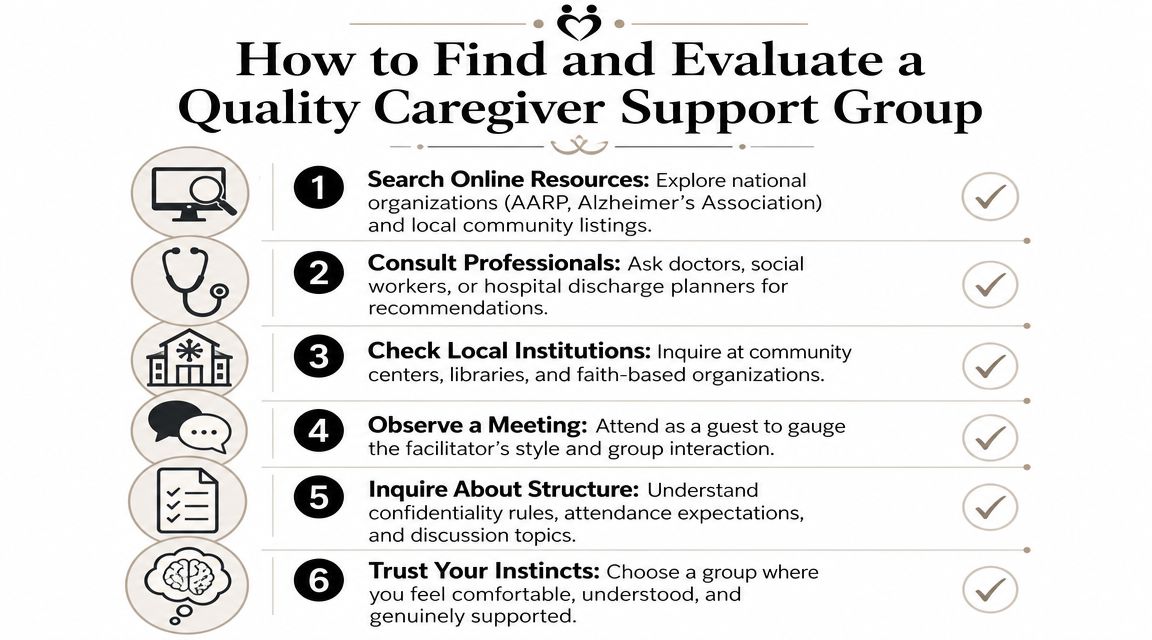
Start with the most reliable referral paths
Begin with organizations that already work with older adults and family caregivers. They tend to know which groups are active, who leads them, and whether they're useful.
Try these in order:
Area Agency on Aging or state aging office
These agencies often know local caregiver programs, respite options, and condition-specific referrals.Hospital social workers and discharge planners
They usually know which groups are practical for families dealing with new diagnoses, rehab, or repeated admissions.Condition-specific organizations
If your parent has dementia, Parkinson's, or another major condition, diagnosis-based organizations can point you to groups that speak your language.Senior centers, community centers, and faith communities
These can be excellent for local connection, especially if you need nearby support rather than national resources.
If you're deciding between virtual options, this guide to online caregiver support groups can help you sort what to ask before joining.
A short video can also help you think through what to look for in a supportive environment.
Ask questions before you attend regularly
Government and health-system guidance consistently points in the same direction. Effective groups do more than offer emotional support. They connect caregivers to formal resources such as respite, care planning, and condition-specific information, turning discussion into action, as reflected in Pennsylvania's caregiver support group guidance.
Use these questions when you contact a facilitator:
- How is the group led? Is there a trained facilitator, or is it completely open discussion?
- What are the ground rules? Ask about confidentiality, respectful listening, and time-sharing.
- What happens if someone is in crisis? A good group should know when to refer beyond the meeting.
- Is this group more for emotional support, practical problem-solving, or both?
- Can I attend once before deciding? A trial visit can save you from committing to a poor fit.
- Do members share resources after meetings? Notes, local contacts, or follow-up links can make the group far more useful.
A quality group should help you leave with one clearer thought, one concrete resource, or one next action.
Watch for warning signs
You don't need perfection. You do need basic safety and usefulness.
Red flags include:
- One person dominates every session
- Advice gets pushy or judgmental
- Confidentiality is treated casually
- The facilitator can't redirect conflict
- Meetings spiral into venting with no support or structure
If you leave two or three meetings feeling more overwhelmed, trust that signal.
How to Participate for Maximum Benefit
You join the meeting after a long day, half listening while folding laundry or sitting in your car outside your parent's appointment. An hour later, the group ends, and you realize you nodded along but never brought up the problem that is keeping you up at night. That happens a lot. Support groups help most when you use them on purpose.
Start each meeting with one issue you want help with. Keep it narrow enough that people can respond in a useful way. “My sister keeps second-guessing me but won't take a shift” will get you farther than “My family is a disaster.” “I don't know what to say when Dad refuses help with bathing” gives the group something real to work on.
Specific questions lead to better support. They also help when your time is tight, which is true for many family caregivers.
Share enough to be known, not so much that you flood the room
I tell caregivers to aim for clear, contained sharing. If you say too little, the group cannot help. If you tell the whole backstory every time, you may leave drained and still not get an answer you can use.
A practical format works well:
- State the situation: “My mother calls me at work over and over because she forgets our plan.”
- Name the pressure point: “I'm becoming resentful, then I feel guilty.”
- Ask for one kind of help: “I need ideas that cut down the calls without making her feel abandoned.”
That gives other members a way in. It also keeps the conversation from turning into a twenty-minute download.
Listen for what repeats
Support groups rarely give you one perfect answer. What they do give, when the group is solid, is pattern recognition.
If five caregivers in different families say that a shared sibling update text reduced arguments, pay attention. If several people say they write one question on an index card before every doctor visit because stress scrambles their thinking, that is worth trying. Repeated small tactics usually matter more than dramatic advice from one person with a very different parent, diagnosis, or family system.
Use what fits your situation. Leave the rest.
Treat the group as one tool in your care system
The most effective members do something with what they hear. They test one idea, notice what happened, and come back with a sharper question the next time.
A few habits make that easier:
- Keep a notebook or note on your phone: Write down one resource, one phrase, or one next step.
- Respect airtime: If you have spoken a lot, pause and let someone else in.
- Follow through on one action: Try one script, one boundary, or one scheduling change before the next meeting.
- Bring problems back in workable form: Ask for help with one decision, one conversation, or one care task.
Trade-offs require careful consideration. A suggestion may sound smart and still be wrong for your family. Advice that works for a nearby sibling may fail if you are caregiving from another city. A tactic that helps with mild memory loss may backfire in later-stage dementia. Good participation means testing ideas against your parent's condition, your limits, and the help you realistically have.
Use boundaries inside the group
You are allowed to pass. You are allowed to say, “I'm here to listen today.” You are also allowed to decline advice that does not fit your parent's needs or your values.
That is not disengagement. It is good judgment.
If you tend to leave meetings wound up, scattered, or unable to remember what was useful, it may help to work on a few basic caregiver stress management strategies between sessions. A calmer nervous system makes it easier to ask better questions, hear what applies, and use the group well.
Starting Your Own Caregiver Support Circle
Sometimes every available group misses the mark. The timing doesn't work. The tone feels wrong. The focus is too broad. If that keeps happening, start smaller.
You do not need to launch an organization. You need two or three other caregivers, a regular time, a basic structure, and a shared agreement that this space will stay respectful and private.
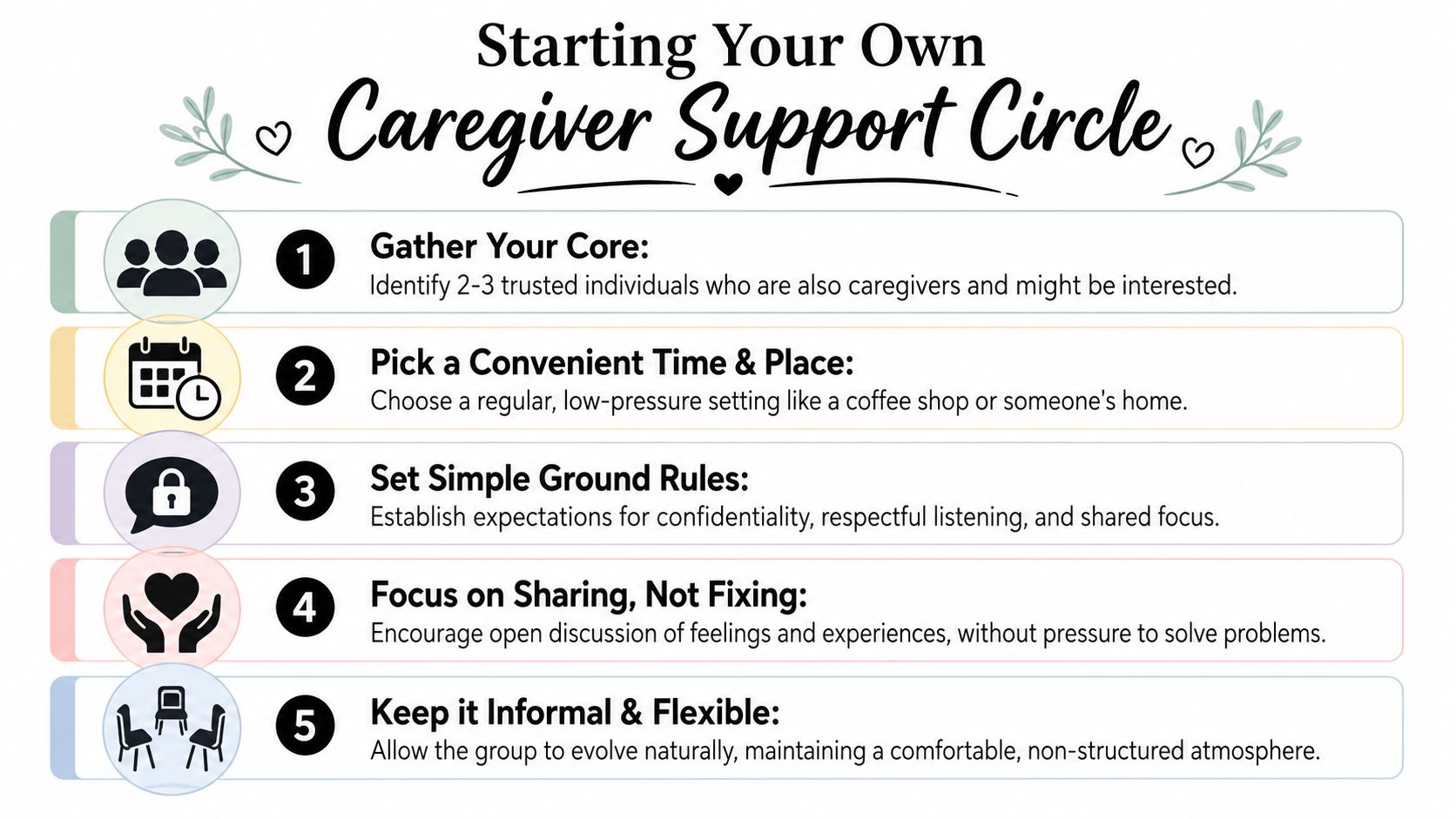
Keep the first version very small
Start with people you can imagine talking to for six weeks. That might be a neighbor caring for her father, a friend from church supporting his mother with memory loss, and someone you met at a rehab facility waiting room.
Don't overbuild it. A small circle often works better than a larger one because members feel safer, attendance is easier to manage, and conversation stays grounded.
Use simple ground rules
Write the rules in one text or email before the first meeting. Keep them plain.
A workable starter set:
- Confidentiality matters: What's shared in the group stays in the group.
- No fixing on demand: Offer ideas only when someone wants them.
- Everyone gets time: No one person takes the whole meeting.
- Specific beats vague: Bring one real issue when possible.
- Kindness is required: No shaming, mocking, or family one-upmanship.
Try a basic meeting rhythm
You don't need a fancy curriculum. Use a repeatable format so nobody has to invent the meeting from scratch each time.
A practical agenda looks like this:
Check-in
Each person gets a few minutes to say what week they're having.Topic of the day
Pick one issue. Examples include managing guilt, dealing with resistant parents, updating siblings, preparing for medical appointments, or handling holidays.Resource swap and next step
End by sharing one useful tool, phrase, or contact. Each person names one action they'll take before the next meeting.
Small groups work when the pressure stays low and the structure stays clear.
Conversation prompts that actually open people up
If everyone is tired, broad questions fall flat. Use prompts that invite specific stories:
- What took the most energy this week?
- Where are you stuck with your parent right now?
- What's one conversation you're avoiding?
- What do you wish your siblings understood?
- What's one task you could stop doing, delegate, or simplify?
If the group starts drifting into chronic venting, redirect gently. Ask, “What kind of support would help most right now?” That question often shifts the room from spinning to problem-solving.
Frequently Asked Questions About Support Groups
At 9:30 p.m., after the medication questions, the sibling text thread, and the third interruption to your workday, it is common to wonder whether a support group will help or just take more time. These are the questions caregivers ask me most, especially when they need support that fits real life instead of adding one more obligation.
Is everything I say confidential
Usually, confidentiality is expected, but do not assume it. Ask how the group handles privacy, whether members agree to ground rules, and what happens if someone breaks them. Good facilitators answer clearly and without hesitation. If they sound vague, choose a different group.
What if I try a group and don't like it
Leave and try another one.
Fit matters more than people expect. A group can be well-meaning and still be wrong for your stage of caregiving, your parent's condition, or your tolerance for emotional intensity. I have seen caregivers give up after one bad meeting when the actual problem was group fit, not the idea of support itself. Try at least two or three options before you decide support groups are not for you.
Do I have to share if I don't want to
No. Listening counts.
Many caregivers need a meeting or two to decide whether the room feels safe and useful. That is especially true if you are working, caregiving, and trying to protect your parent's privacy at the same time. If speaking live feels like too much, look for a group that allows drop-in attendance, camera-off participation, or anonymous online discussion. Accessible formats matter, as noted in this GoodRx overview of caregiver support groups.
Are there groups for adult children and not just spouses
Yes. Many groups include adult children who are juggling work, parenting, long-distance coordination, and difficult conversations with siblings. Before you join, ask who typically attends and what caregiving situations come up most often. That quick screening step can save you weeks in a group that does not match your reality.
What if my issues are partly legal or decision-making related
Support groups help you sort through stress, family conflict, and next-step thinking. They do not replace legal advice.
If questions about capacity, authority, or court involvement are starting to shape your decisions, use the group to test your questions and hear how other families handled similar pressure points. Then pair that support with a legal resource, such as this guide to parent guardianship in Texas, when the issue becomes concrete.
Can online groups really help
Yes, if the group is moderated well and easy for you to attend consistently. I would rather see a caregiver join a solid 45-minute online group every other week than keep missing the ideal in-person group across town. The best group is the one you can return to when things get hard.
If you're carrying too many decisions alone, Family Caregiving Kit offers practical guides, worksheets, and tools that help families organize eldercare tasks, compare options, and turn overwhelm into clear next steps.