
A simple routine of morning stretches for seniors is one of the best tools we have for pushing back against daily stiffness and making movement feel good again. It's about taking a few quiet moments after waking up to gently greet your body, get the blood flowing, and set a positive, comfortable tone for the entire day.
How a Simple Stretch Can Transform Your Morning
Does waking up with stiff joints and tight muscles sound familiar? That feeling isn't just in your head. Our bodies naturally tighten up overnight, which can make that first trip from the bed to the kitchen for coffee feel like a slow, cautious shuffle. For example, your hamstrings might feel so tight that bending to pick up the newspaper from the porch seems like a major task.
There's a real reason for this daily morning stiffness. Research has found that our muscles are often at their most inflexible right around 6-7 AM, with hamstring flexibility gradually improving as the day goes on. For older adults, this isn't just a minor inconvenience; that temporary rigidity can increase the risk of a fall by up to 30%. You can actually read more about how the time of day affects our bodies in this detailed research on diurnal assessments.
Reclaiming Your Mornings with Gentle Movement
What if you could start each day feeling more secure and less achy? A consistent morning stretching routine offers a way to do just that. This isn't about a strenuous workout, but rather a gentle conversation with your body before the day's demands begin.
This small habit pays huge dividends, changing how you feel and move.
- Feel Safer on Your Feet: Gently waking up your muscles and joints helps that first step out of bed feel more stable. For example, stretching your calves and ankles can prevent your foot from "catching" on the rug as you walk to the bathroom.
- Make Daily Tasks Easier: A few minutes of stretching can make all the difference when bending to tie shoes, reaching for a mug on a high shelf, or getting out of the car without a groan.
- Get Your Blood Flowing: Movement is the best way to improve circulation. A simple seated leg stretch can help reduce that "pins and needles" feeling you might get after sitting for a while.
A simple, consistent stretching routine is one of the most accessible tools you have for improving your quality of life. It’s a promise to yourself that today will be a day of greater comfort and independence.
By setting aside just ten minutes each morning, you're actively fighting back against stiffness. This isn't about becoming a gymnast; it's about making everyday life feel better. It’s a small investment of time that empowers you to start the day with more freedom and on your own terms.
Your Pre-Stretch Safety Checklist
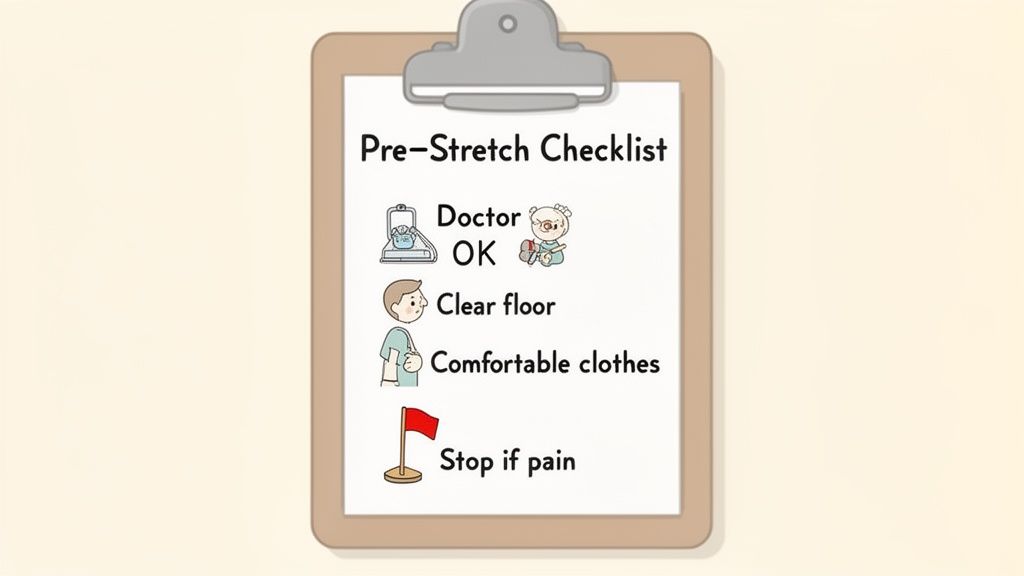
Before you even think about the first stretch, we need to run through a quick safety check. Just a few minutes of preparation can be the difference between a great morning routine and an unnecessary risk. Think of it as laying a solid, safe foundation for every movement you make.
This isn't just about avoiding injury; it's about building confidence. When you know you're in a safe space, you can relax and truly benefit from the morning stretches for seniors we're about to cover.
First things first, have a quick chat with your doctor. This is an absolute must if you're managing any chronic conditions like osteoporosis, severe arthritis, or heart issues. For example, ask them, "I'm thinking of starting a gentle morning stretching routine for my stiff back. Are there any specific movements I should avoid?"
Prepare Your Space and Yourself
With your doctor's green light, it’s time to look at your surroundings. A clear, safe area lets you move freely and without worry.
- Scan for Hazards: Take a moment to clear the floor. An actionable step is to walk through your intended stretch area and physically move any throw rugs, tuck away loose cords from lamps or phones, and push ottomans out of the way.
- Set Up Your Support: Always stretch near something sturdy you can hold onto for balance. A stable chair (one without wheels!), a kitchen counter, or even a wall works perfectly. Test your support by giving it a gentle push to ensure it doesn't wobble.
- Dress for Success: Wear clothes that are loose and breathable. Cotton t-shirts and sweatpants are a great choice. Avoid restrictive jeans or slippery socks on a hard floor.
Taking these few simple steps makes a world of difference. If you want to do a more thorough safety sweep of your home, our home safety checklist for seniors is a great resource.
Know When to Stop
Here’s the single most important rule I can share: listen to what your body is telling you. The goal is always a mild, gentle pulling sensation—never pain.
The philosophy is simple: start low and go slow. Never push your body into a position that causes sharp, shooting, or sudden pain. If you feel dizzy, lightheaded, or unusually short of breath, stop immediately and rest.
For example, if you are stretching your neck and feel a sharp "zing" down your arm, that is a signal to stop immediately. A correct stretch would feel like a gentle, steady pull along the side of your neck, not a jolt of pain. Recognizing these signals is what makes a stretching routine sustainable.
Seated Morning Stretches for Everyday Mobility
You don't have to leap out of bed to start your day off right. In fact, some of the very best morning stretches for seniors can be done from the comfort and safety of a sturdy chair. This routine is perfect if you're just getting started, dealing with limited mobility, or find yourself a bit dizzy or unsteady in the mornings.
Think of the chair as your anchor. It gives you the stability to focus purely on the movements, gently waking up your body without putting any strain on your joints. We’ll focus on the areas that get the tightest overnight—your neck, shoulders, back, and legs.
Gently Releasing Your Neck and Shoulders
We tend to hold a lot of tension in our neck and shoulders while we sleep. A few simple stretches can work wonders to release that stiffness, which can improve your posture and even help fend off tension headaches.
- The Neck Tilt: First, sit tall with your feet flat on the floor and your back feeling straight but not rigid. Now, very slowly and gently, tilt your right ear toward your right shoulder. You're looking for a light, easy stretch along the left side of your neck. Hold it there for 20-30 seconds while taking a few deep breaths. Come back to the center and repeat on the other side.
For a caregiver, a helpful prompt is: “Pretend a string is softly pulling your ear to your shoulder. Only go as far as feels comfortable.” A practical tip is to place your left hand under your thigh to keep the shoulder down and deepen the stretch slightly.
Waking Up Your Spine
A flexible spine is key for so many daily movements, from turning to look behind you to getting out of a chair with ease. The Seated Cat-Cow is a fantastic way to bring some gentle, fluid motion to your entire back.
- Seated Cat-Cow: Scoot forward to the edge of your chair so your feet are flat on the floor, and place your hands on your knees. As you breathe in, gently arch your back, open up your chest, and look slightly ahead (the "Cow" part). As you breathe out, round your spine, tuck your chin toward your chest, and let your shoulders slump forward (the "Cat" part). Flow between these two positions 5-8 times, letting your breath guide the movement.
This simple back-and-forth movement acts like a lubricant for the vertebrae in your spine, easing stiffness and promoting better posture throughout the day.
This particular motion gets to the root of a lot of common aches. It's a staggering fact that by age 65, nearly 50% of seniors report dealing with chronic lower back pain, often tied to a stiff spine and inflexible hips.
To give you an idea of how effective this can be, one study found that older women who did targeted stretching for just eight weeks saw their sacral and hip joint range of motion improve by an amazing 34%. This directly helped ease their back pain. The key is consistency and holding static stretches for 30-60 seconds to really see those gains. You can read more about the impressive results of this flexibility training for older adults in the study itself.
Your Seated Morning Stretch Sequence
Here’s a quick reference table to guide you through this simple seated routine. It's designed to be a gentle start, so listen to your body and only do what feels good.
| Stretch Name | What It Helps | Quick Guide |
|---|---|---|
| Neck Tilt | Eases neck and shoulder stiffness | Sit tall. Gently tilt your ear toward your shoulder. Hold for 20-30 seconds each side. |
| Seated Cat-Cow | Mobilizes the entire spine | Inhale to arch your back (Cow). Exhale to round your spine (Cat). Repeat 5-8 times. |
| Ankle Rotations | Boosts lower leg circulation | Lift one foot. Slowly draw 5-10 circles with your ankle in each direction. Switch feet. |
| Seated Hamstring Stretch | Stretches the back of the thighs | Extend one leg, heel on the floor. Hinge at the hips to lean forward gently. Hold for 20-30 seconds each side. |
This sequence is a great foundation. As you get more comfortable, you can increase the hold times or add more repetitions.
Awakening Your Legs and Feet
Even before you get on your feet, you can get the circulation moving in your lower body. This is crucial for shaking off that "heavy leg" feeling and getting you ready for the day.
- Ankle Rotations: While seated, simply lift one foot off the floor. Slowly begin to rotate your ankle as if you were drawing a circle in the air with your big toe. Make 5-10 slow circles in one direction, then reverse and do 5-10 more in the other. Switch to the other foot and repeat. For a practical visual, imagine you are tracing the outline of a dinner plate with your foot.
- Seated Hamstring Stretch: Extend one leg straight out, resting your heel on the floor with your toes pointing toward the ceiling. Keeping your back straight, hinge forward from your hips until you feel a gentle stretch down the back of your thigh. Hold for 20-30 seconds, and remember to breathe! Then, switch legs. An actionable tip is to place your hands on your thighs for support and avoid rounding your lower back.
These seated movements are a fantastic and safe way to begin. If you're feeling good and want to explore more ways to stay active, our guide on the best exercises for seniors to improve overall fitness is a great next step.
Supported Standing Stretches for Better Balance
If you've warmed up with some seated movements and feel steady, easing into a few supported standing stretches is the perfect next step. This routine is for anyone who's comfortable on their feet but still wants the reassurance of something solid to hold onto.
Find a sturdy support you can trust—the kitchen counter, a wall, or the back of a heavy, unmovable chair works great. Having that support lets you relax and focus on your form and balance, which is what this is all about. These movements are specifically chosen to wake up the muscles that keep you stable, helping you feel more confident throughout your day.
The link between a quick morning stretch and your balance is stronger than most people realize. Falls are a genuine concern, contributing to over 684,000 deaths worldwide each year, and seniors can be more vulnerable, especially in the morning when joints are stiff. In fact, research shows that active stretching combined with balance exercises boosts stability far more than just doing balance work on its own. It's a powerful fact, especially since our flexibility is at its lowest when we first wake up. You can dig deeper into the science behind how stretching enhances balance in older adults in this fascinating study.
Building a Strong and Stable Base
Let's focus on the lower body and core—the powerhouse muscles that hold you upright. Just remember to keep a light touch on your support. It’s there to catch you, not to hold you up.
- Standing Calf Stretch: Stand facing your support with your hands resting on it. Step one foot back, keeping the leg straight and your heel firmly on the floor. Now, gently bend your front knee until you feel a nice, easy stretch in the calf of your back leg. Hold it for 20-30 seconds; really feel that muscle lengthen. Then, slowly switch legs and do the other side. As an actionable insight, focus on pressing your back heel down toward the floor to maximize the stretch.
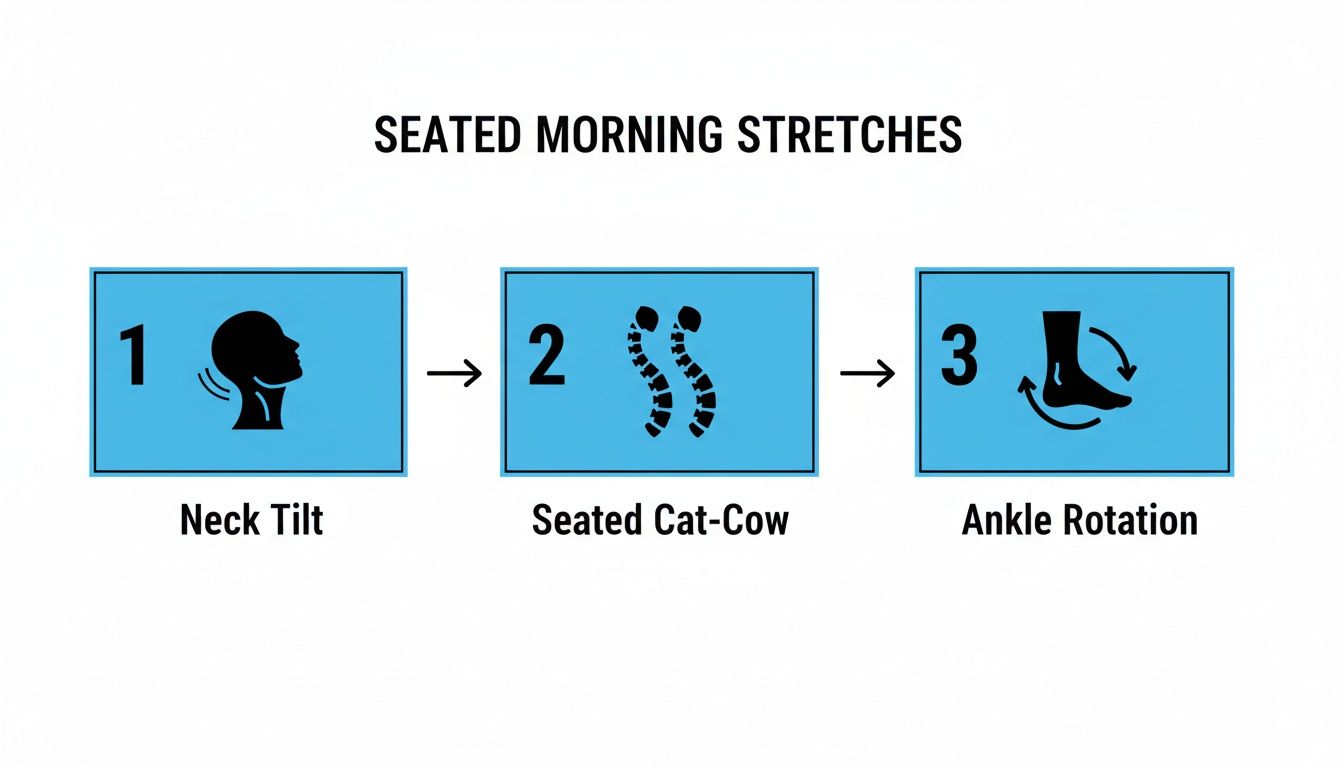
Simple movements like the seated ones shown above are excellent for waking up the body and preparing your muscles for the standing stretches we're doing now.
Improving Leg Strength and Flexibility
Having strong, pliable leg muscles is your best defense against a stumble or trip. These next two stretches get right into the large muscles of your thighs, which you use all day for everything from getting out of a chair to climbing stairs.
Using a support for balance isn't a crutch; it's a smart tool. It gives you the confidence to safely explore a greater range of motion, and that’s where you’ll find the biggest gains in flexibility and stability.
Supported Quad Stretch: Stand tall, holding your support with one hand. Bend your other knee, bringing your heel up toward your bottom. With your free hand, gently take hold of your ankle. You’re looking for a good stretch along the front of your thigh. Try to keep your knees close together and your back straight. Hold for 20-30 seconds, release gently, and switch. A practical example if you can't reach your ankle: loop a dish towel around your foot and hold the ends to gently guide your heel upward.
Standing Hamstring Stretch: Stand facing your support and place the heel of one foot on a low, sturdy surface. The bottom step of a staircase or a solid footstool is perfect. Keep that leg straight. Now, placing your hands on your hips or your support, gently hinge forward from your hips—not your waist—until you feel a stretch in the back of your thigh. Hold for 20-30 seconds, then repeat on the other side. An actionable tip is to keep your toes pointed toward the ceiling to get a deeper stretch.
Consistently doing these supported stretches doesn't just build physical resilience; it builds confidence. For even more practical ways to stay safe and steady, check out our guide on fall prevention tips for seniors.
How to Build a Lasting Stretch Habit
The real secret to making any new routine stick is turning it into an automatic habit. The great news is, when it comes to morning stretches for seniors, consistency beats intensity every time. You don’t need a grueling, complicated workout to feel a world of difference.
The goal here is to simply weave gentle movement into your morning until it feels as normal as pouring that first cup of coffee. To do that, you have to start small. An actionable starting point is to choose just three seated stretches and commit to doing them for five minutes.
Find Your Starting Point
Listen to your body—it will tell you what it needs. A great way to begin is by committing to stretching just three to five days a week. This keeps you from feeling overwhelmed and makes it much easier to stay on the path.
For example, you could "habit stack" by deciding to do your stretches in your favorite chair right after you take your morning medication. Linking the new habit (stretching) to an existing one (taking pills) makes it far more likely to stick. There's no single "correct" schedule; the best one is the one you can actually stick with without it feeling like a chore.
As you get stronger and more flexible, you’ll instinctively know when it’s time to add more. That five-minute routine might start feeling a bit short, and you'll naturally feel ready to add a standing stretch. Let your own progress be your guide.
Make Every Stretch Count
To get the most out of your time, how you stretch is just as important as which stretches you do. The old advice to just hold a stretch for a few seconds simply isn't enough to create lasting change in your muscles.
For seniors, most experts agree on a specific benchmark: hold each static stretch for 30-60 seconds. This gives your muscles and the surrounding tissues the time they need to truly relax and lengthen, which is how you get real, noticeable gains in flexibility.
Here's an actionable way to practice this: while holding a hamstring stretch, slowly count to 30 in your head. As you count, focus on taking slow, deep breaths—inhaling through your nose and exhaling through your mouth. This keeps you from holding your breath and allows the muscle to relax more deeply.
Track Your Progress to Stay Motivated
There's nothing more motivating than seeing proof that your efforts are paying off. A simple stretching log can be the tool that turns your good intentions into a solid, daily practice. It gives you a real, tangible record of how far you’ve come, which is especially helpful on those days when you just aren't feeling it.
You don't need anything fancy. A spare notebook or a simple chart you print out will do the trick perfectly. Here’s a practical example of a "Stretching Log" entry:
- Date: Monday, Oct 23
- Stretches Done: Neck Tilt, Cat-Cow, Ankle Rotations
- How I Felt: "Woke up very stiff. Felt much looser after, especially in my neck."
- Notes: "Held each stretch for 30 seconds. Felt the stretch in my left calf more than my right."
This simple act of writing it down builds a powerful sense of accountability. It’s a way to celebrate your own consistency and create a visual reminder of your commitment to feeling better, one stretch at a time.
Your Questions Answered: A Guide to Senior Stretching
It’s completely normal to have a few questions when you’re starting something new. Let's tackle some of the most common ones I hear from seniors and their families about getting a morning stretch routine off the ground.
Is Some Mild Discomfort Normal When Starting?
Yes, feeling a gentle pull in the muscle you're stretching is not only normal, it's a good sign! That light tension tells you the muscle is responding. However, that sensation should never cross the line into sharp, sudden, or shooting pain.
For example, a gentle pull in the back of your thigh during a hamstring stretch is good. A sharp pain behind your knee is bad. If a movement truly hurts, that's your body waving a red flag. Stop and ease off. That initial feeling of tightness will naturally decrease over a few weeks as your flexibility improves.
Can These Stretches Really Help With Arthritis Pain?
Absolutely. In fact, gentle stretching is one of the best non-medical things you can do to manage arthritis. Moving and stretching helps lubricate the joints, which can dial down that familiar morning stiffness and help you maintain your precious range of motion.
For a practical approach, start with very small movements. If a full neck tilt feels like too much, just gently look left and then right. The goal is to encourage movement, not to force a deep stretch, especially on days when your joints feel particularly sensitive.
What if I Have Had a Hip or Knee Replacement?
This is a big one. If you have a joint replacement, it is absolutely critical that you get the green light from your orthopedic surgeon or physical therapist before you start any new stretching program. They know the exact details of your surgery and are the only ones who can give you truly personalized advice.
Your medical team will give you a clear roadmap. For instance, after a hip replacement, they will likely give you a permanent list of movements to avoid, such as crossing your legs or bending your hip past 90 degrees. Your safe stretching routine must be built around these specific instructions.
Your new joint is a marvel of engineering, but it has its own set of rules. Your surgeon and PT wrote the rulebook. Don't start a new routine without their direct approval—it's essential for your safety and long-term health.
How Can I Motivate a Loved One to Stick With It?
Let's be honest—nagging rarely works. True motivation often comes from feeling connected and having a positive experience. The best way to encourage a loved one is to ditch the pressure and make it a shared, enjoyable activity.
Here are a few actionable examples:
- Do It Together: Say, "Let's do our five-minute stretches together before we have our coffee." Your presence is the best motivation.
- Set the Mood: Put on their favorite calming music from their youth, like big band or classical. Creating a pleasant atmosphere makes a world of difference.
- Focus on Showing Up, Not Perfection: Keep the sessions short and sweet. Celebrate the simple act of doing it with a "Great job today!" even if it's just for five minutes.
- Connect It to a Goal They Care About: Frame the routine around something meaningful. Try saying, "If we keep our legs stretched, it will be easier to walk to the mailbox without your cane," or "This will help us get down on the floor to play with the grandkids."
When you turn a task into a rewarding shared moment, you're not just building a healthy habit—you're making a positive memory. That simple shift can be all it takes.
At Family Caregiving Kit, we provide the practical tools and clear guides you need to navigate eldercare with confidence. Our resources are designed to turn complex decisions into manageable steps for busy families. Explore our workbooks and decision aids at https://blog.familycaregivingkit.com.