
You're standing at the pharmacy counter, looking at a total that makes no sense. Or you're sorting through pill bottles at the kitchen table, realizing your parent has started stretching doses because the refill was too expensive. That's often the moment caregivers start searching for prescription drug assistance. Not because they have extra time, but because they've run out of options.
If that's where you are, treat this like triage. Don't try to learn every program in one night. Start with the medication that can't be skipped, the bill that's due first, and the application that has the best chance of working. Families get stuck when they chase every possible lead at once. What works better is a short, deliberate sequence.
The First Step is Acknowledging the Problem
Most caregivers minimize this problem at first. They tell themselves the price spike is temporary, or that next month will be easier, or that maybe the doctor's office already knows what to do. Meanwhile, the refill date gets closer.
This issue extends beyond one family's bad luck. As of 2024, nearly 16% of U.S. persons under age 65 lack prescription drug insurance, which leaves many people paying out of pocket or relying on assistance programs, according to Healthy People's prescription drug insurance objective. Even people who do have insurance often find that one drug isn't covered well enough to be affordable.
That matters because caregivers usually don't walk into a clean, simple system. They walk into a mess. One medication is on formulary, another needs prior authorization, a third has a copay that might as well be cash pay, and nobody explains the difference clearly.
Start with the question that matters most
Ask this first: What is the medication problem today?
Not “What's every program available?”
Not “What should we do for the whole year?”
Ask:
- Which medication is unaffordable right now
- When is the next refill due
- What happens if it's missed
- Does the patient have no insurance, Medicare, Medicaid, private coverage, or coverage that still leaves the drug unaffordable
That last group gets overlooked all the time. A patient can be technically insured and still not be able to pay for the drug they need. That's where many caregivers waste time applying to programs that automatically exclude anyone with active coverage.
Practical rule: Don't start by filling out forms. Start by sorting the problem into one clear category: uninsured, Medicare-based, Medicaid-based, privately insured but under-covered, or in a temporary gap after a job change or plan disruption.
If you want one place to organize medication details, refill timing, and questions before you call around, tools like Rx360 can help caregivers keep the facts straight when the situation feels scattered.
Once you can name the problem precisely, the system gets less intimidating. You stop chasing “help” in general and start targeting the kind of help that fits.
Understanding the Four Paths to Assistance
Busy caregivers do better when they stop thinking of prescription drug assistance as one giant program. It's really four different lanes. Each lane has different rules, different paperwork, and different chances of success.
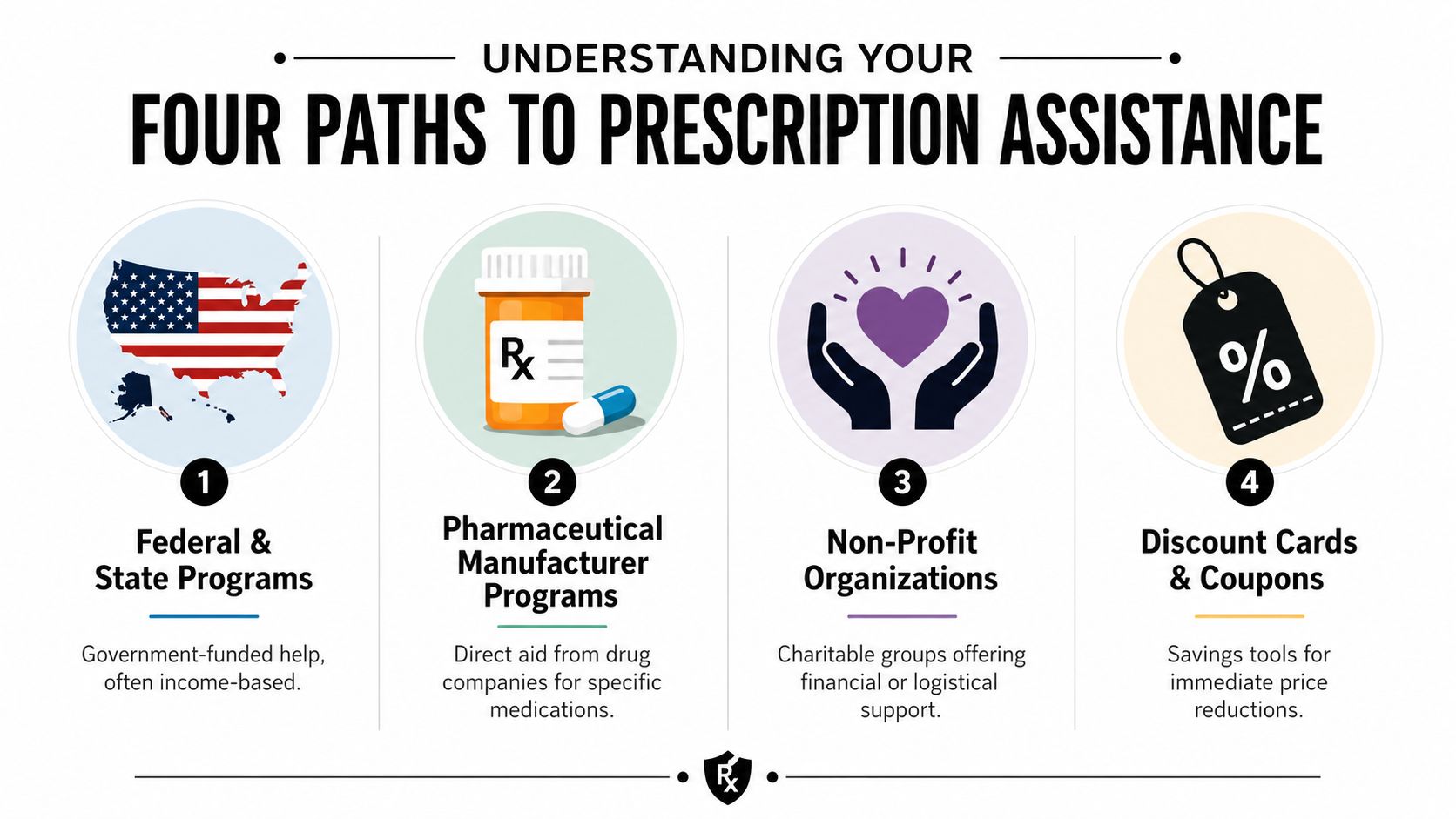
In practical terms, you're trying to answer two questions. Who offers the help, and what kind of help is it? That keeps you from applying to a copay program when what you really need is a full replacement supply, or waiting on a foundation that won't cover the drug at all.
In 2021, 18 million U.S. adults struggled to afford their prescriptions. The available safety net includes about 2,000 Patient Assistance Programs from nearly 500 drug companies, offering free or discounted medicine to people who meet income criteria, typically 2 to 4 times the Federal Poverty Level, according to this review of prescription medication affordability and assistance programs. If you need a quick income reference before applying, keep a Federal Poverty Level chart open while you work.
Path one is Federal and State Programs
This is the first lane to check when the patient has Medicare, limited income, or lives in a state with extra prescription help. These programs can reduce ongoing costs instead of giving one-time relief.
Examples include:
- Medicare Extra Help: Best for Medicare beneficiaries with limited income and resources.
- State Pharmaceutical Assistance Programs: Useful when your state offers drug-specific or population-specific support.
- Medicaid-related prescription coverage: Important when a patient may qualify but hasn't completed enrollment.
This lane is often more stable than coupons or temporary cards. The trade-off is paperwork, eligibility screening, and slower approval.
Path two is Manufacturer Patient Assistance Programs
Drug companies often run their own Patient Assistance Programs, or PAPs, for specific medications. These can be excellent when a brand-name drug has no affordable substitute.
The catch is that manufacturer help is usually drug-specific, not patient-wide. You may solve the cost for one medication and still have no answer for the others. It also means you need the exact drug name, dose, prescriber, and insurance status before you start.
Path three is Charitable and nonprofit support
Some charities help with copays, premiums, transportation, or condition-related treatment expenses. This lane works best when the patient's diagnosis matches a foundation's mission and when funds are open.
Funding windows can be unpredictable. Caregivers often lose time here by assuming a charity will fill every gap. It won't. But for the right diagnosis, it can be the bridge that keeps treatment going.
Some caregivers need medication help. Others need navigation help just as badly.
That's especially true in mental health care, where families are juggling therapy, psychiatry, and medication access at the same time. If you're trying to compare accepted plans while sorting treatment options, a practical directory for mental health insurance coverage Ohio can save time for Ohio families.
Path four is Discount cards and community resources
This lane is fastest, but it's usually the least complete. Discount cards, pharmacy savings tools, local clinics, and community-based support can lower the immediate cash price. They don't usually solve the deeper insurance problem.
Use this lane when:
| Situation | Best use |
|---|---|
| Refill is due now | Get a temporary lower price while larger applications are pending |
| Patient doesn't qualify for formal aid | Compare cash prices and local options |
| Coverage exists but copay is still high | Check whether a cash discount beats the insurance price |
This lane is useful, but it's not a full affordability plan. Think of it as pressure relief, not the whole fix.
Building Your Pre-Application Toolkit
Before you fill out a single application, gather the paperwork. This step feels slow, but it's what prevents forms from stalling halfway through. Most rejections and delays happen because a caregiver starts searching before they've built a usable file.

Patient Assistance Programs typically require applicants to be permanent legal U.S. residents, prove they are uninsured or that their plan excludes the needed medication, meet specific income thresholds, and submit documentation like tax forms and proof of residence, as explained in GoodRx's overview of Patient Assistance Programs. That means your first job is not “find help.” Your first job is “build proof.”
What to gather before you apply
Use one folder, paper or digital. Don't scatter this across text messages, kitchen drawers, and email attachments.
- Patient identification: Driver's license, state ID, Social Security information if required, and proof of address. Programs use this to confirm identity and residency.
- Insurance documents: Front and back of insurance cards, Medicare or Medicaid details, pharmacy benefit card, and any denial letters. If the patient is underinsured, this paperwork proves the gap.
- Income records: Recent tax return, pay stubs, benefit statements, or other income documentation. Most programs screen on household income, not stress level.
- Medication list: Drug names, strengths, dosing schedule, prescribing clinician, and pharmacy. If you already use a tracking system, keep it current. This guide on building a medication management system can make the list easier to maintain.
- Clinical details: Diagnosis, recent visit notes if available, and the prescriber's contact information. Some programs need the doctor to complete part of the form.
- Household information: Number of people supported by the income in the home. That can change eligibility.
Why this matters for the inadequately insured
Caregivers with uninsured relatives often know what story they're telling. Caregivers with insured relatives get tripped up because the situation sounds contradictory. “Yes, she has insurance. No, the medication still isn't affordable. No, the plan doesn't really cover it in a usable way.”
That's why you need documents that show the gap plainly.
For example:
- A formulary notice showing the drug isn't covered
- A pharmacy printout showing the patient responsibility
- A denial after prior authorization
- A note showing the plan covers the drug only at a cost the family can't sustain
Those details matter when a program asks whether the patient is uninsured, underinsured, or excluded from coverage for that medication.
Bring the denial, the copay amount, and the formulary status together in one packet. A vague explanation gets brushed aside. A documented gap gets reviewed.
Make a one-page summary
This is the single handiest tool for calls and applications. Put these items on one page:
- Patient name and date of birth
- Medication name and dose
- Prescribing doctor and contact
- Insurance type
- What the pharmacy said the patient owes
- Refill due date
- What documents you already have
- What kind of help you're seeking
A practical example: if your father takes an expensive inhaler and the pharmacy says the refill cost is out of reach, your one-page summary should show the inhaler name, his Medicare or commercial plan, the refill date, and whether the doctor has tried alternatives already. That makes every next step faster.
Executing Your Search and Application Strategy
Once your toolkit is ready, move in order. Don't bounce from website to website. The best search strategy is triage, not browsing.

If I were helping a caregiver with this in real time, I'd start with the medication that must not be interrupted. Think insulin, heart medication, seizure medication, anticoagulants, transplant drugs, serious psychiatric medications, or a critical pulmonary inhaler. Then I'd sort the patient into the right lane and apply in a specific order.
Step one is check Medicare and state help first
If the patient has Medicare, start there before looking at coupons or manufacturer forms. For Medicare beneficiaries, the Extra Help program can eliminate drug costs for those with 2026 income under $23,940 for an individual and limited resources. You can apply through Medicare.gov or the Social Security website, as summarized by the PAN Foundation's Extra Help guide.
Use state counseling too. A local State Health Insurance Assistance Program guide can help you find the right SHIP contact when plan rules are confusing.
A realistic example: your mother has Medicare Part D, takes a brand-name diabetes medication, and the monthly cost is no longer manageable. Before calling the manufacturer, check whether she qualifies for Extra Help or a state-based option. If she does, you may solve the underlying cost issue more cleanly.
Step two is target the manufacturer for the exact drug
If federal or state help doesn't solve it, go straight to the drug maker's patient assistance page or phone line. Have your one-page summary in front of you.
Say something like this:
“I'm calling for my mother. She has active coverage, but the prescribed medication is still not affordable. I need to know whether your patient assistance program accepts underinsured patients when the plan does not provide practical access to the medication.”
That wording matters. Don't just say, “We need help.” State the coverage problem clearly.
If the representative says the program is only for uninsured patients, ask two follow-up questions:
- Does the program allow exceptions if the insurance excludes this medication or leaves an unaffordable patient responsibility
- Do you have a separate savings, bridge, or temporary supply option while we pursue an appeal
Step three is involve the prescriber's office early
Many applications fail because the clinician portion sits untouched. Call the office and be direct.
Use language like:
- “I'm applying for prescription drug assistance for this medication. Who in your office handles PAP forms or prior authorization paperwork?”
- “Can you confirm the exact diagnosis and medication details you want listed so the application matches your records?”
- “If this drug remains unaffordable, is there a clinically appropriate lower-cost alternative you'd consider?”
This is also where caregivers should ask whether the office has a medication assistance coordinator, social worker, pharmacist, or nurse who handles forms regularly. Experienced staff can spot avoidable mistakes fast.
Here's a short explainer that's worth watching before you start calling programs:
Step four is document every contact
Use a simple call log. Write down:
| What to track | Why it matters |
|---|---|
| Date and time | Helps when you need follow-up |
| Organization and phone number | Prevents repeated confusion |
| Representative name | Useful if you need escalation |
| What they asked for | Keeps paperwork moving |
| Deadline or next step | Stops applications from expiring |
Step five is use a same-day fallback
Don't leave the pharmacy empty-handed if the medication is urgent and the long-term application is still pending. Ask the pharmacist and prescriber about short-term options such as a therapeutic alternative, a smaller fill, or a temporary lower cash price route while paperwork moves.
A practical example: if your uncle's pulmonary medication is unaffordable and the refill is due in two days, submit the assistance application, but also ask the prescribing office whether they can provide a sample, change to an alternative covered option, or support an urgent formulary exception. The best caregivers work both tracks at once.
Troubleshooting Common Rejections and Roadblocks
At this stage, many families give up too early. A rejection letter feels final. Often it isn't. It's just the first answer from a system that didn't fully understand the case, or didn't fit the patient neatly into its default categories.
One of the biggest blind spots in prescription drug assistance is the insured patient who still can't get the drug affordably. In 2019, 24% of adults had trouble affording medication, and many with inadequate private or government coverage were denied assistance that was available to the uninsured, according to this analysis of medication affordability gaps and underinsurance barriers.
Rejection number one is “You have insurance”
This is the classic underinsured trap. The program sees active coverage and stops there. But coverage on paper isn't the same as access in real life.
When that happens, respond with documentation, not emotion. Send:
- The denial letter or formulary exclusion
- A pharmacy printout showing the patient share
- Any prior authorization denial
- A short statement from the prescriber explaining medical necessity
Write the appeal in plain language. For example:
The patient has active insurance, but the prescribed medication is not reasonably accessible under that coverage. The plan either excludes the medication, requires unaffordable cost sharing, or has denied authorization. We are requesting reconsideration based on inadequate functional coverage for this specific drug.
Rejection number two is “Income is too high”
Families hate this one because it can be technically true and still absurd in practice. A retired couple may miss the income cutoff and still have no room in the budget for a costly medication.
When that happens, try a three-part response:
- Ask whether gross or net household income was used
- Confirm household size was entered correctly
- Ask whether there is an exception, hardship review, or alternate program for underinsured patients
Some programs won't budge. Others have a second review path that only appears if you ask directly.
Rejection number three is hidden insurance obstacles
Some families get approved for copay assistance and still see no real relief at the pharmacy. That can happen when the insurance plan uses accumulator or maximizer rules that prevent copay assistance funds from counting toward the patient's deductible or out-of-pocket maximum. Caregivers don't need to master the jargon, but they do need to ask smart questions.
Ask the insurer:
- Does manufacturer copay assistance count toward the deductible
- Does it count toward the out-of-pocket maximum
- Will using assistance change what the patient owes later in the year
Don't ask, “Do you take the card?” Ask, “How does this assistance get applied inside the plan?”
What to do when the front door stays closed
If one route fails, shift the route instead of repeating the same failed application.
Try this sequence:
- Ask the prescriber about a clinically appropriate alternative
- Request a formulary exception or appeal
- Check state-specific options
- Ask for a social worker, pharmacist, or benefits counselor to review the case
- Use a temporary discount path while appeals continue
A practical example: your aunt has private insurance, but her specialty dermatology medication still costs far more than she can handle. The manufacturer denies help because she has insurance. Instead of stopping there, ask the doctor for a formulary exception, confirm whether a therapeutic substitute exists, and ask the insurer exactly how specialty-tier cost sharing works. That often reveals the next effective move.
Creating Your Long-Term Affordability Plan
A medication crisis gets attention. A medication system prevents the next one. That's why prescription drug assistance shouldn't be treated as a one-time rescue only.
This matters for health, not just budgets. Financial medication assistance improved adherence from 48.5% at baseline to 72.7% after six months in one pharmacy service program, according to this review of financial medication assistance and adherence outcomes. When patients can afford the medicine, they're far more likely to stay on it.
Build three habits that keep costs from turning into emergencies
The first habit is track renewal dates. Many assistance programs require re-enrollment, updated income proof, or a new prescription. Put those deadlines on a shared calendar and set reminders well before the refill crisis starts.
The second habit is bring cost into every medical visit. Caregivers often wait until the pharmacy rejects a claim. Ask earlier. Say, “Before you send this in, is there a lower-cost option, a preferred alternative, or a program your office uses for this medication?” That question saves time because it reaches the issue before the bill arrives.
The third habit is review coverage and medication lists at least once a year. Plans change. Formularies change. Household finances change. A drug that was manageable last year may become the budget breaker this year.
Keep one affordability file, not scattered scraps
Use one folder for:
- Current medication list
- Insurance cards and plan notes
- Application copies
- Approval and denial letters
- Renewal dates
- Names of helpful contacts
If you want help finding lower-cost care options, pharmacy support, or community navigation tools that fit into a broader affordability strategy, resources from the Kindness Community Foundation can be useful for ongoing comparison and planning.
A good affordability plan is boring. That's the point. It replaces surprise with routine.
Caregivers don't need a perfect system. They need one that works on a busy Tuesday when the pharmacy text comes in and nobody has time for another scramble.
If you want more practical caregiver tools, planning worksheets, and plain-English guides for handling medical, financial, and day-to-day care decisions, visit Family Caregiving Kit. It's built for families who need clear next steps, not more overwhelm.