
Finding your path through Illinois disability services often starts the same way. A school transition meeting raises PUNS. A doctor mentions an ISC. A family friend tells you to call Community Alternatives Unlimited, but no one explains what that agency does, whether it serves your address, or how it fits with waiver services, day programs, or housing.
That confusion is normal. In Illinois, the IDD system runs on roles, referrals, and geography. Community Alternatives Unlimited in IL is often one of the first names families hear because ISC agencies sit near the front door of the system. They help with eligibility steps, PUNS enrollment, updates, planning, and ongoing coordination. If you're also weighing day supports, this guide on choosing day services for adults can help once you're further along.
The practical question isn't just “Which agency is best?” It's “Which agency covers my address, understands my family's priorities, and communicates in a way I can use?” That's where families save time, avoid repeat paperwork, and stop chasing the wrong office. Below are 10 options that matter, starting with Community Alternatives Unlimited and then widening out to other ISC agencies and statewide supports that families use when trying to get unstuck.
1. Community Alternatives Unlimited (CAU)
Community Alternatives Unlimited is the best-known starting point for many families on Chicago's North Side and in nearby northern suburbs. It was founded by Joanell Voigt and incorporated in 1980 as the first Independent Service Coordination agency in Illinois. Its own materials say it is now the oldest ISC provider in the state, and it coordinates services for people with intellectual and developmental disabilities while also partnering with pregnant women and families for maternal-child health support through its CAU about page.
That history matters in practice. A long-established ISC usually knows the array of local providers, the state process, and the paperwork rhythm that can slow families down.
What families usually use CAU for
CAU is a coordination agency, not primarily a direct care provider. Families typically turn to it for PAS or ISC intake, eligibility screening, PUNS enrollment and updates, person-centered planning, waiver-related advocacy, and help narrowing choices among residential, day, and Home-Based Services options.
A common example is a parent of a young adult leaving school services who needs to do three things at once: confirm eligibility, keep PUNS current, and understand whether day programming or home-based supports make more sense first. CAU can help sequence that work.
Practical rule: Ask at the first call whether your address is inside CAU's service area before discussing provider choices. That saves a lot of backtracking.
Trade-offs to know
CAU's biggest strength is also its limitation. It has deep regional knowledge, but it does not serve all of Illinois. Independent directory information and CAU's own description show that it serves Chicago's north side, Northwest Cook County, Hanover Township, Lake County, and parts of the North Shore and northern suburbs through the DSCC resource listing for Community Alternatives Unlimited.
If you live outside that footprint, CAU may still point you in the right direction, but it won't be your assigned ISC. High demand can also affect response time, which is common in agencies handling complex state-linked coordination.
2. Community Service Options, Inc. (CSO)
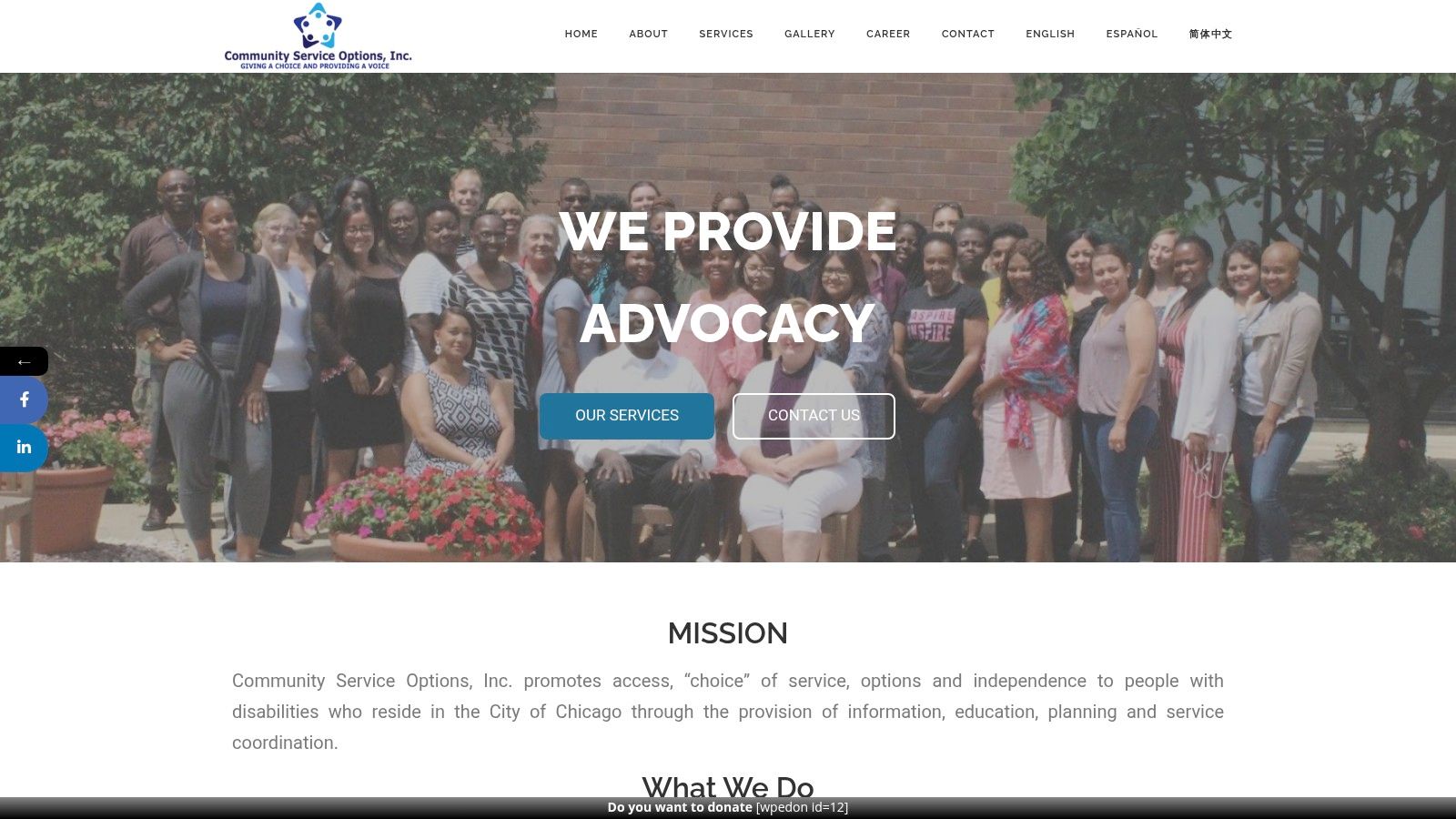
If your family is inside the city and you want a Chicago-focused ISC, Community Service Options often makes more sense than calling a suburban agency first. CSO is designated for parts of the City of Chicago and is built around the same core ISC functions families need early on: eligibility help, PUNS work, ISSA involvement for waiver recipients, and person-centered planning.
What works well here is city familiarity. When families are comparing transportation realities, neighborhood-based programs, or provider fit inside Chicago, local knowledge matters more than broad statewide visibility.
Where CSO fits best
CSO is a strong option when your immediate challenge is city-based navigation rather than legal advocacy or provider shopping on your own. It helps families understand what programs exist under the Illinois system and how to move through intake without confusing the ISC role with the direct service role.
That distinction is easy to miss. Families often assume the ISC will provide the day program, staff, or residential setting. It won't. The ISC helps assess, document, plan, and connect.
For relatives also learning the broader long-term support system, this plain-language overview of long-term care services can help you frame what belongs to coordination and what belongs to direct care.
Trade-offs to know
CSO's biggest practical limitation is geography. If you're outside its assigned city area, the agency may not be the right entry point. Its website is also concise, so families usually get the clearest answers by calling with a short list of direct questions:
- Address check: Ask whether your exact home address falls in CSO's ISC coverage area.
- Process check: Ask what documents to gather before intake.
- Communication check: Ask who handles follow-up if your assigned coordinator is unavailable.
Families do better when they treat that first phone call like a working intake, not just a request for general information.
3. Service, Inc. of Illinois (Service, Inc.)
Service, Inc. of Illinois is a practical choice for families in parts of northern and northeastern Illinois who want an ISC with a clear operational role. Based in Joliet, it handles the standard functions that tend to matter most after diagnosis or during transition years: intake, PUNS enrollment and updates, person-centered planning, linkage to DDD-funded services, and ongoing coordination.
One thing families appreciate about agencies like Service, Inc. is clarity around follow-up expectations. If your relative already receives waiver-funded supports, the cadence of contact and advocacy becomes just as important as the original intake.
What it's good at
Service, Inc. works best for families who want help moving from “we know we need services” to “we need to compare actual local options.” That often includes sorting through residential placements, day services, home-based supports, and eligibility redeterminations.
A realistic example is a family whose adult son is on PUNS, then receives movement toward funded services and suddenly has to make decisions quickly. The ISC becomes the organizer. It won't choose for you, but it can frame what options exist in your region and what paperwork has to happen in what order.
Trade-offs to know
The downside is straightforward. You must live in the agency's designated counties to receive support there, and demand can affect appointment timing. Families sometimes interpret a delayed callback as a dead end, when it's often a sign to be more structured in follow-up.
Try approaching the conversation this way:
- Lead with the need: “We need help with PUNS status and planning for adult services.”
- Name the deadline: “School exit is coming soon,” or “caregiver health is declining.”
- Ask for the next action: “What should we send before the first meeting?”
You can contact the agency directly through the Service, Inc. of Illinois website.
4. Suburban Access, Inc.

Suburban Access is one of the agencies families often find after realizing Chicago and suburban Cook County aren't interchangeable in the ISC system. Based in Homewood, it serves south and west suburban Cook County and nearby areas, with a strong emphasis on independence, inclusion, and practical community navigation.
For first-time caregivers, that matters. A clear explanation of what the ISC can do tends to reduce panic faster than a polished website ever will.
Where it stands out
Suburban Access is useful when the family's needs don't fit neatly into one box. You may be sorting through respite, home-based supports, day programming, and basic community resource questions at the same time. In those situations, an agency that can help with both formal IDHS-linked coordination and broader local navigation is often more helpful than one that only talks in waiver language.
A common suburban scenario is an aging parent still caring at home, with siblings trying to step in before a crisis forces a rushed placement. At this point, families need honest guidance about what can happen now, what requires waiting, and what needs backup planning.
Ask whether the agency can help you prioritize immediate supports while longer-term funding pathways stay in process.
Trade-offs to know
Suburban Access, like every ISC, has bounded geography. If you live outside its designated suburban region, you'll need a different assigned agency. Some program details also require direct contact, so don't expect the website alone to answer every operational question.
Use the Suburban Access website to start, then call with specific questions about address eligibility, PUNS updates, and whether your current concern is intake, transition planning, or a change in need.
5. Southern Illinois Case Coordination Services (SICCS)
Families in southern Illinois face a different reality than families in Chicago. Distance changes everything. Provider options may be farther apart, in-person meetings can take more planning, and housing questions often become central earlier because there may be fewer nearby alternatives.
That's why Southern Illinois Case Coordination Services stands out. SICCS serves a very large southern Illinois region from Centralia and goes beyond basic intake support by offering housing navigation, transition-related help, outreach tied to community integration, and crisis availability including on-call emergency response.
Why rural and regional coverage matters
An ISC covering a wide area has to work differently. Families may need more phone coordination, more advance scheduling, and more persistence in documenting changes in need. The upside is that SICCS is built for a broad territory, not just one metro pocket.
A practical example is a family in a smaller community where the nearest day or residential provider isn't close by. In that case, the ISC's value isn't just paperwork. It's helping the family understand what's realistically available in the region and how to build a plan around that.
Trade-offs to know
Wide coverage can slow travel and scheduling. Families sometimes mistake that for lack of engagement when it's really geography shaping logistics. The best approach is to stay active in communication and confirm what should trigger outreach from you between formal contacts.
Useful questions include:
- Urgency planning: What should we do if care at home becomes unsafe before the next scheduled meeting?
- Housing planning: Is there a housing navigation path that fits our county?
- Contact rhythm: Who should we call for status updates?
You can start with the SICCS website.
6. Central Illinois Service Access (CISA)
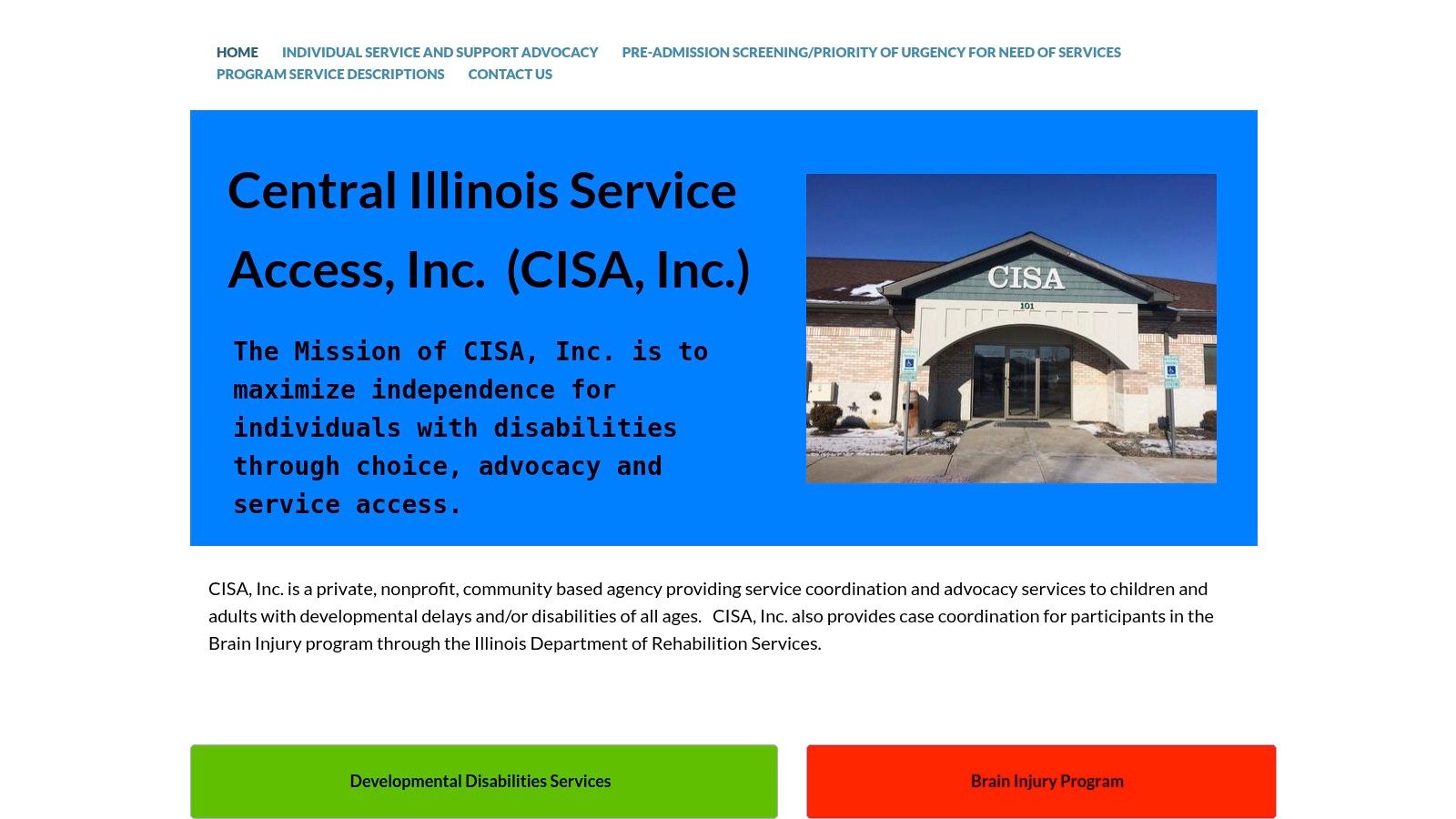
Central Illinois Service Access is the kind of agency families often appreciate more after the first conversation than before it. The website is basic, but that doesn't tell you much about day-to-day usefulness. In practice, CISA is a central Illinois ISC that helps with PAS functions, PUNS support, planning, advocacy, and cross-program coordination.
That last part matters when a family's life doesn't fit a single system. Some households are dealing with developmental disability services alongside school transition, behavioral supports, rehabilitation history, or brain injury-related questions.
Best fit for families juggling multiple systems
CISA is a strong match when you need someone who can hold the whole picture together. Not every coordinator can do that equally well. Some are strongest on waiver mechanics. Others are better at helping a family understand how one service decision affects transportation, daily supervision, caregiver workload, and future housing.
If you're still learning the role itself, this explainer on what a service coordinator does is useful before your first call.
What to listen for: A good coordinator doesn't just recite eligibility steps. They can explain your next two or three decisions in plain language.
Trade-offs to know
Because CISA's online information is limited, families often need to call to get specifics. That can feel old-fashioned, but it also means your best information may come from a direct conversation rather than a generic web page.
Have these points ready before calling the Central Illinois Service Access website:
- Current status: Is your relative already on PUNS, or are you starting from scratch?
- Immediate concern: Is the issue transition, caregiver burnout, day services, or housing?
- County information: Confirm your exact county so you reach the right office or contact.
7. Prairieland Service Coordination, Inc.
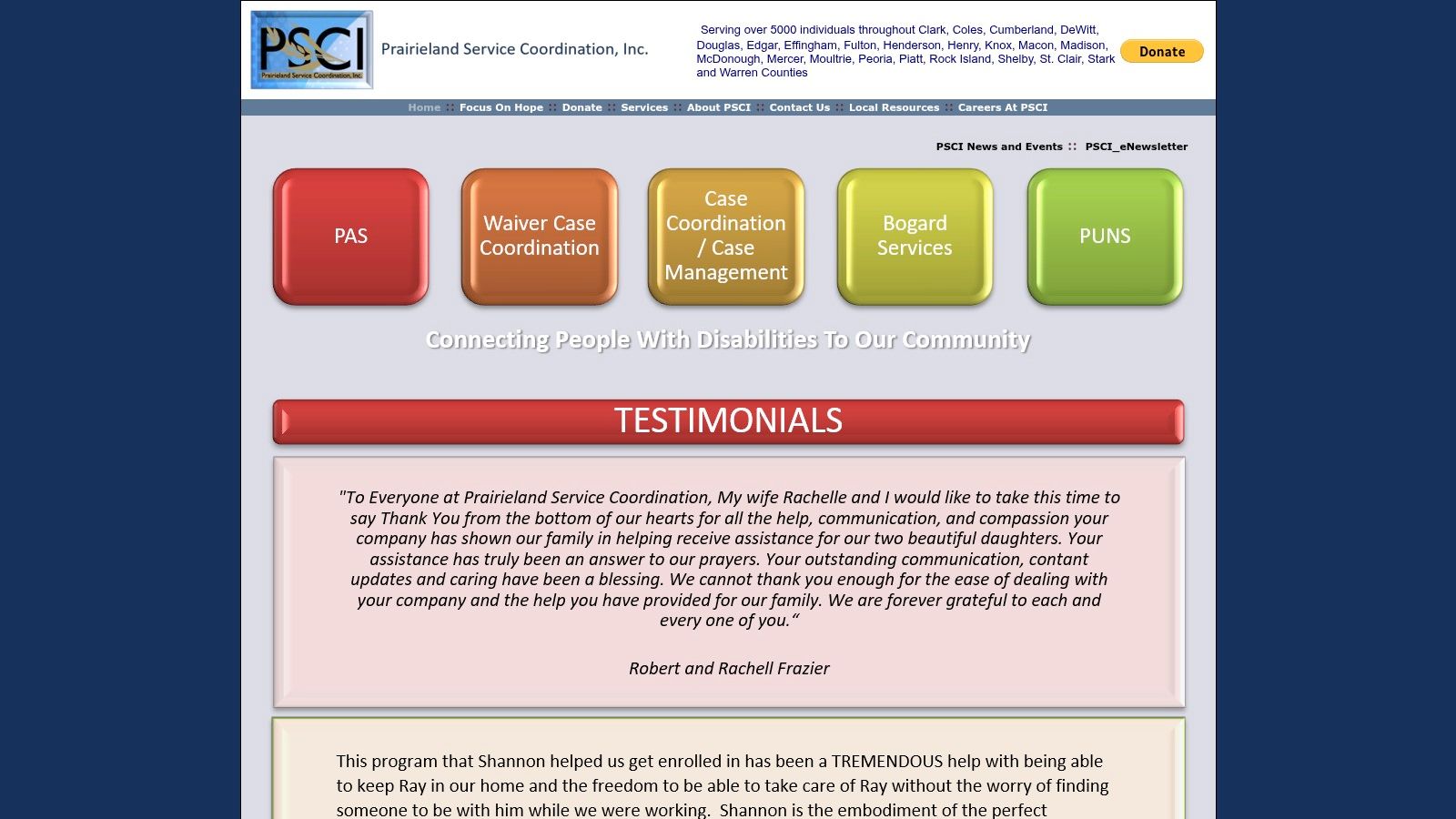
Prairieland Service Coordination serves Area J counties in central and east-central Illinois and is a practical option for families who need county-level familiarity more than broad branding. That local knowledge can make a real difference when provider choices vary sharply from one county to the next.
In this part of Illinois, two families may both have waiver-related questions but face completely different local realities. One county may have multiple known providers. Another may require wider travel, wait-and-see planning, or more creative use of supports.
Why county-specific contacts help
Prairieland's county-by-county contact setup is useful because it mirrors how families navigate the system. They don't need a statewide lecture. They need to know who handles their area and what provider network that person understands.
This agency tends to be a good fit when you want someone who understands the local network well enough to say, “These are the provider types you're likely to encounter here,” instead of offering abstract advice.
Trade-offs to know
The website is limited, and many families will need to rely on phone or email to understand the details. That's not unusual for ISC agencies, but it does mean you should come prepared.
A solid first email or call usually includes:
- Your county and town: This matters immediately for routing.
- Your family member's age and general stage: Child, transition-age, or adult seeking supports.
- Your top need right now: PUNS enrollment, update, waiver planning, or provider connection.
You can reach the agency through the Prairieland Service Coordination website.
8. The Arc of Illinois Family Advocate Program
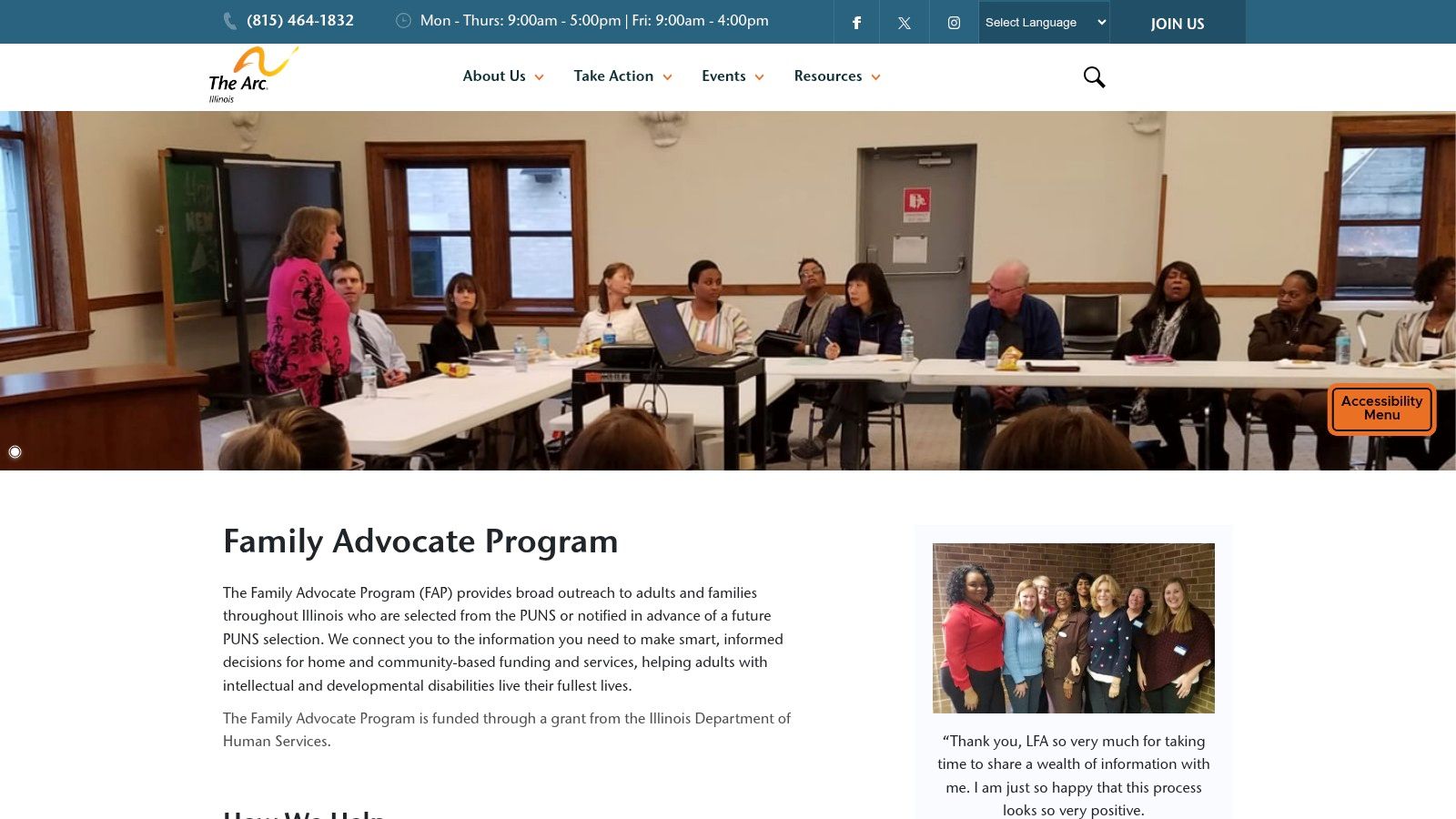
This isn't an ISC, and that's exactly why it belongs on the list. The Arc of Illinois Family Advocate Program helps families after a Ligas award letter arrives, when many people suddenly discover that being selected for funding doesn't automatically tell them how to build a workable support plan.
Families often hit this point with a mix of relief and panic. They've waited, advocated, and completed the earlier system steps. Then they have to decide how to practically use waiver funding in real life.
Where this program helps most
The Family Advocate Program offers family-to-family guidance, which is often more practical than formal system language. It can help families think through individualized supports, understand what questions to ask, and make better use of waiver options without replacing the assigned ISC.
A useful example is a family deciding between concentrating resources on home-based staffing, using supports to increase community access, or pursuing a more residential pathway. The advocate won't take over case management, but they can help the family prepare for those conversations and avoid common misunderstandings.
Trade-offs to know
This program is not the right front door if you're still trying to get on PUNS or determine your assigned ISC. It's most useful after selection into the relevant pathway. It also doesn't replace formal case coordination.
Think of it as a translator and coach, not the agency that authorizes or manages the system steps. You can learn more through The Arc of Illinois Family Advocate Program.
9. The Arc of Illinois Illinois Life Span
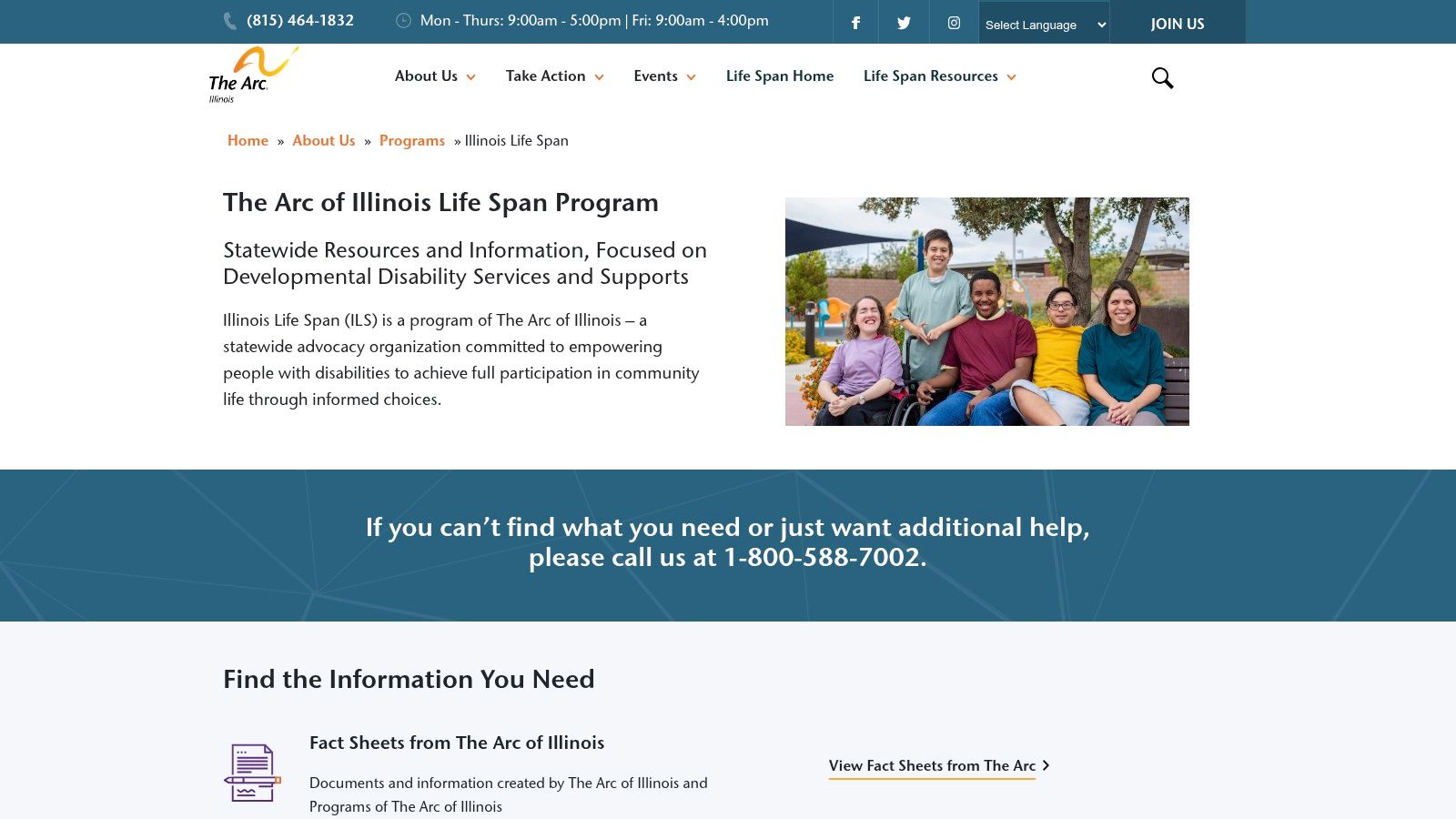
Illinois Life Span is one of the best statewide starting points for families who know they need help but don't yet know which door to knock on. Unlike an ISC, it doesn't handle your formal case management. What it does well is orientation. It gives families a neutral place to find county-based information, plain-language explainers, and help locating the correct local ISC.
That's especially useful for people considering Community Alternatives Unlimited in IL, even though they live somewhere CAU doesn't serve. A statewide resource can stop that misfire early.
When to use Illinois Life Span
Use Illinois Life Span when you need to answer one of these questions:
- Who covers my county or address?
- What is PUNS, and why do people keep telling us to update it?
- What's the difference between an ISC and a direct service provider?
For brand-new caregivers, those aren't small questions. They shape every next step.
If you feel lost, start with the statewide explainer before calling three different agencies that can't actually serve your area.
Trade-offs to know
Illinois Life Span is an information and referral resource, not a substitute for your assigned ISC. The depth of local detail can also vary depending on the county and the specific issue you're dealing with.
Still, it's often the fastest way to stop guessing and start working from the right map. Families can use the Illinois Life Span website for resource searches, educational materials, and guidance toward the appropriate local system contact.
10. Equip for Equality
Equip for Equality belongs on this list because not every problem in the Illinois disability system is a coordination problem. Some are rights problems. Services stall. Schools resist. A setting may raise safety or community integration concerns. A family may need legal advocacy or self-advocacy support, not another provider list.
Equip for Equality is Illinois' protection and advocacy agency. That independence matters when the issue is conflict, denial, access, abuse or neglect concerns, or broader rights-based barriers.
Best use cases
Families usually reach out to Equip for Equality when something has gone wrong or when they need to understand their rights before things get worse. That can include disability-related rights concerns, special education issues, community integration barriers, or situations where a person's voice isn't being respected.
It's also useful for self-advocates and family members who want training and tools for speaking up more effectively.
Trade-offs to know
This is not a placement agency and not a service coordinator. If your main need is getting onto PUNS, finding your ISC, or comparing day program providers, start elsewhere. If your problem is a dispute, rights issue, or serious systems concern, this may be the right place.
A practical way to decide is simple. If you're asking, “Who coordinates services?” call an ISC. If you're asking, “What are our rights and what can we do about this?” contact Equip for Equality.
Comparison of 10 Illinois Community Service Providers
| Organization | Core Services ✨ | Target 👥 | Coverage & Cost 💰 | Notable Strengths 🏆 | Quality ★ |
|---|---|---|---|---|---|
| Community Alternatives Unlimited (CAU) | PAS/ISC intake, PUNS, ISSA, residential/HBS linkage ✨ | Families of people with IDD needing ISC 👥 | North Side Chicago + north/nw suburbs; IDHS‑funded / regional eligibility 💰 | Long-established ISC with large caseload & provider network 🏆 | Experienced staff; high demand can slow response ★★★★☆ |
| Community Service Options, Inc. (CSO) | PAS/eligibility, PUNS, ISSA, person-centered planning ✨ | City of Chicago residents with IDD 👥 | City of Chicago only; IDHS‑funded / regional eligibility 💰 | Chicago-focused expertise; conflict-free case management 🏆 | Strong city network; website concise, call for details ★★★★☆ |
| Service, Inc. of Illinois (Service, Inc.) | PAS/ISC, PUNS, quarterly ISSA, provider linkage ✨ | Families in Joliet & surrounding counties 👥 | Northern/NE Illinois counties; IDHS‑funded / county eligibility 💰 | Multi-county reach with clear ISSA scope 🏆 | Reliable coordination; appointment demand may delay ★★★★☆ |
| Suburban Access, Inc. | ISC, PUNS, HBS/respite linkage, community navigation ✨ | South & west suburban Cook County caregivers 👥 | Suburban Cook County & nearby areas; IDHS‑funded 💰 | Clear guidance for first-time caregivers; inclusion focus 🏆 | Helpful orientation; some program details require contact ★★★★☆ |
| Southern Illinois Case Coordination Services (SICCS) | PAS/ISC, PUNS, SODC transition, Housing Navigator, 24/7 crisis ✨ | Families across southern Illinois, incl. rural areas 👥 | 31 southern IL counties; IDHS‑funded / wide territory 💰 | Housing navigation and after-hours crisis support 🏆 | Broad coverage; travel/scheduling can affect in-person visits ★★★★☆ |
| Central Illinois Service Access (CISA) | PAS/ISC, PUNS, person-centered planning, brain injury expertise ✨ | Central Illinois families; complex/cross-program needs 👥 | Central IL multi-county footprint; IDHS‑funded 💰 | Strong cross-program coordination & brain injury experience 🏆 | Experienced coordinators; website info limited ★★★★☆ |
| Prairieland Service Coordination, Inc. | PUNS, Medicaid Waiver linkage, county-specific contacts ✨ | Area J county caregivers (Macon, Champaign, Coles) 👥 | Area J (central/east‑central IL) counties; IDHS‑funded 💰 | Local, county-level provider familiarity & contacts 🏆 | Good local ties; details often via phone/email ★★★★☆ |
| The Arc of Illinois – Family Advocate Program (Ligas) | One-on-one coaching after Ligas awards, Waiver planning, webinars ✨ | Families with Ligas award letters (post-selection) 👥 | Statewide for awardees; free to eligible families 💰 | Family-to-family plain‑language coaching; peer-informed support 🏆 | High-touch help for awardees; not a substitute for ISC ★★★★★ |
| The Arc of Illinois – Illinois Life Span (ILS) | Statewide resource DB, county listings, webinars, helpline ✨ | New caregivers seeking neutral statewide guidance 👥 | Statewide resources & helpline; free 💰 | Neutral first-stop with county-by-county referrals 🏆 | Regularly updated; local depth varies by county ★★★★☆ |
| Equip for Equality | Legal advocacy, self-advocacy training, monitoring & investigations ✨ | People/families needing rights-based legal support 👥 | Statewide protection & advocacy; free but capacity-limited 💰 | Independent legal/rights advocacy for disputes & systemic issues 🏆 | Critical for rights cases; services subject to demand/funding ★★★★☆ |
From List to Action Choosing Your Service Coordinator
A list only helps if it leads to a concrete next step. In Illinois, the first thing to verify is which ISC is assigned to your address. Families lose a lot of time by calling the most visible agency rather than the correct one. That happens often with Community Alternatives Unlimited in IL, because people find the name online and assume it's statewide when it serves a defined regional footprint.
Once you confirm the right ISC, treat the first conversation like an interview. You're not interviewing them for whether they deserve to exist. You're learning how they work, how clearly they explain the process, and whether they can respond to the reality your family is living with now. A good first call should leave you knowing the next document to gather, the next form to update, and the next decision you'll likely face.
Ask practical questions, not broad ones. “How do you handle communication?” works better than “Can you help us?” Ask whether email is okay for routine follow-up, what happens when a coordinator is out, and how the agency handles urgent changes in need. If your family member is transitioning from school, ask how early to start planning. If the main caregiver is aging or burned out, say that plainly. It helps the coordinator understand urgency and context.
Also ask where their role ends. That one question prevents a lot of frustration. An ISC coordinates, monitors, advocates, and connects. It usually does not become the residential provider, day program, transportation company, or legal representative. Families do better when they understand that distinction early and build their own comparison process for actual providers.
I usually encourage families to keep one running document with names, dates, questions asked, and promised follow-up. That simple habit makes every later call easier. It also helps siblings or other relatives step in without starting from zero.
If you need a more structured way to compare agencies, services, and notes from each call, a worksheet can do a lot of heavy lifting. Family caregivers often make better decisions when the options are visible side by side instead of living in scattered emails and voicemails. The right coordinator won't just move paperwork. They'll help your family turn a complicated system into manageable next steps.
If you want practical tools for comparing agencies, tracking calls, and organizing next decisions, Family Caregiving Kit offers plain-language guides and worksheets designed for real families handling complicated care logistics.