
Your phone rings during work. It's your mother in New Orleans saying she missed another appointment because she couldn't get a ride. Or maybe your uncle is still living alone, but the fridge is mostly empty and the laundry is piling up. You know he needs help. You just don't know where to start.
That's where many families get stuck. They aren't unwilling. They're overwhelmed.
If you're searching for the Council on Aging in New Orleans, you're probably looking for one practical thing: a real starting point. Not a maze of agencies. Not ten tabs open in your browser. Just the next right step.
In Orleans Parish, that starting point is often the New Orleans Council on Aging, also called NOCOA. For caregivers, it can function as the front door to meals, transportation, senior centers, in-home support, and other forms of guidance for older adults.
This guide is written for the family member who has to make the first call, gather the paperwork, ask the right questions, and keep things moving. I'll keep the language plain, point out where families often get confused, and give you checklists you can effectively use.
Navigating Eldercare in New Orleans
You get one clue at a time. A missed meal. A stack of unopened mail. A doctor's visit that never happened because no one could provide a ride. Each problem can look small on its own. Together, they usually mean an older adult needs more support than the family has been able to patch together informally.
That early stage is often the hardest. You are trying to tell the difference between a rough week and a pattern. You are also trying to figure out whether the first step should be meals, transportation, help at home, or a call to a local agency that can sort out what fits.
A good way to approach eldercare is to treat it like triage. Start with what affects safety and daily life first, then work outward.
What families are usually trying to solve
The need is not always “full-time care.” More often, it is a group of practical gaps that have started to pile up:
- Skipped meals can mean shopping, standing to cook, or remembering mealtimes has become difficult.
- A cluttered or dirty home can signal pain, fatigue, fall risk, or trouble keeping up with basic chores.
- Missed medical appointments often point to a ride problem or trouble organizing details.
- Confusion about bills, letters, or benefit forms may mean the older adult needs help with paperwork and follow-through.
That distinction matters. If a caregiver says, “Dad can't manage alone anymore,” the next useful question is, “Which daily tasks are breaking down first?”
That question gives you something concrete to report when you call for help. It also keeps you from chasing the wrong service.
Start with the daily problem you can name clearly. “She has food in the house but is not cooking,” is enough to begin.
Why one organized starting point helps
Families rarely need one answer. They need a process.
A central aging-services contact point helps because it works like a front desk for a large building. You do not need to know every office in advance. You need one informed person who can listen, explain the rules, tell you what documents may be needed, and point you to the right next step.
That is the practical value caregivers are usually looking for in New Orleans. They want clear eligibility rules. They want to know whether services are limited to Orleans Parish, whether age or income affects access, and what paperwork to gather before making calls. They also need a simple order of operations, first phone call, screening, documents, follow-up, then service start.
This kind of organized intake matters even more when you are balancing work, children, and a relative's growing needs. A short checklist can reduce hours of confusion. For organizations that serve large member communities, tools that streamline non-profit memberships can help keep outreach and enrollment organized. For family caregivers, the principle is similar. Clear records and one starting point make the whole process easier to handle.
If you feel behind, you are not. Many families wait until the pattern is impossible to ignore. The useful step now is simple. Write down the top two or three daily problems, gather basic identifying information, and start with the agency that can help sort services in the right order.
What the New Orleans Council on Aging Actually Is
For a caregiver, the hardest part is often figuring out who is supposed to do what.
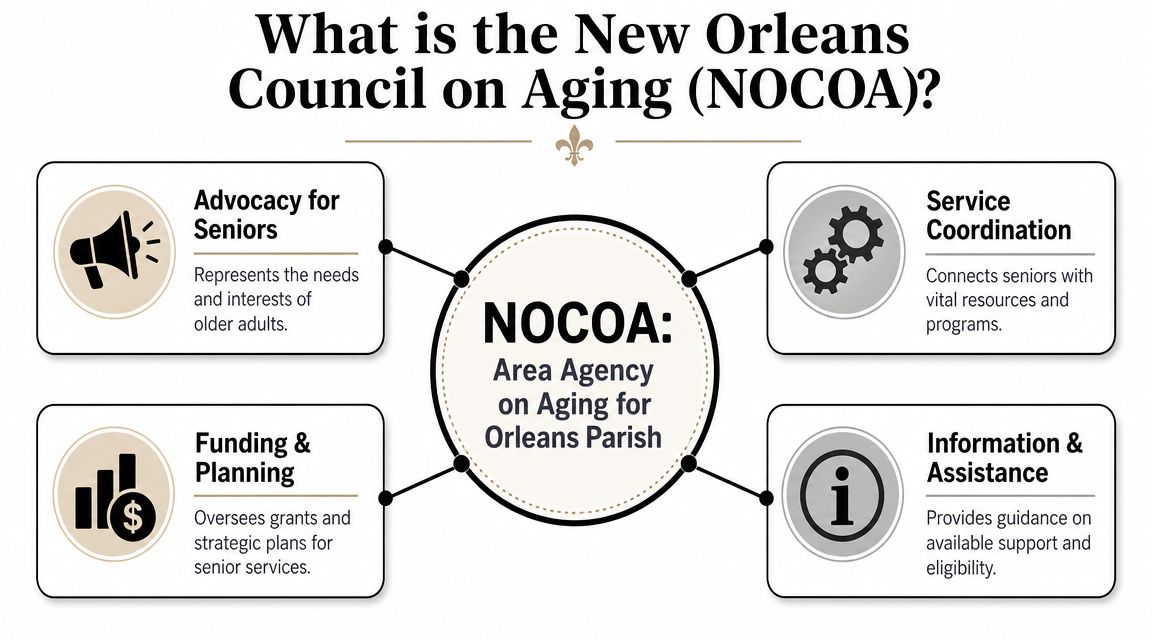
The Council on Aging in New Orleans helps with that sorting process. NOCOA serves as the Area Agency on Aging for Orleans Parish, which means it is the local hub that helps older adults and family caregivers identify needs, understand available programs, and get connected to the right support.
That title can sound formal. In practice, it usually means one place can help you turn a broad concern into a clearer plan.
What NOCOA actually does in practice
NOCOA describes its role as connecting older adults to services such as benefits help, housing support, healthcare access, meals, transportation, senior centers, and in-home assistance, according to the organization's public service overview. The word that matters most is connecting.
That distinction helps families avoid a common misunderstanding. A council on aging may provide some services directly and arrange or refer for others. So when you call, you do not need to know the exact program name first. You need to explain the daily problem clearly, the same way you would describe symptoms before getting a diagnosis.
For example, a caregiver might say:
- “My mother skips meals because cooking has become too tiring.”
- “My uncle is still at home, but housekeeping and safety are slipping.”
- “My father misses medical appointments because no one is free to drive him.”
Those are workable starting points. Staff can often help translate those concerns into service categories, screening questions, and the next step in the process.
Why this role gets confusing
Families often expect a single agency to either hand out information or provide every service itself. NOCOA's role is broader and more practical than either of those labels. It helps organize the front end of eldercare. That includes listening, screening, explaining options, and directing families toward the programs that fit the older adult's situation.
A good way to approach the first call is to focus on function. What is the older adult no longer able to do safely or consistently? Eat regular meals? Get to appointments? Keep up the home? Manage alone during the day? That kind of detail gives intake staff something concrete to work with.
Practical rule: Describe the daily problem first. Ask for the matching program second.
This approach also saves caregivers time. You spend less energy guessing which office to call and more energy gathering the information that will move an application forward. For organizations that need systems to streamline non-profit memberships and track many participant records, the same lesson applies. Clear intake and organized follow-up make it easier to connect people with the right help.
A Look Inside NOCOA's Key Programs
A caregiver often starts with a sentence like, "My mother needs help at home," but the faster route is to name the daily task that keeps breaking down. Meals are missed. Laundry piles up. Getting out of the house has become rare. Once you sort the problem into one of those buckets, NOCOA's programs become much easier to understand and ask for.
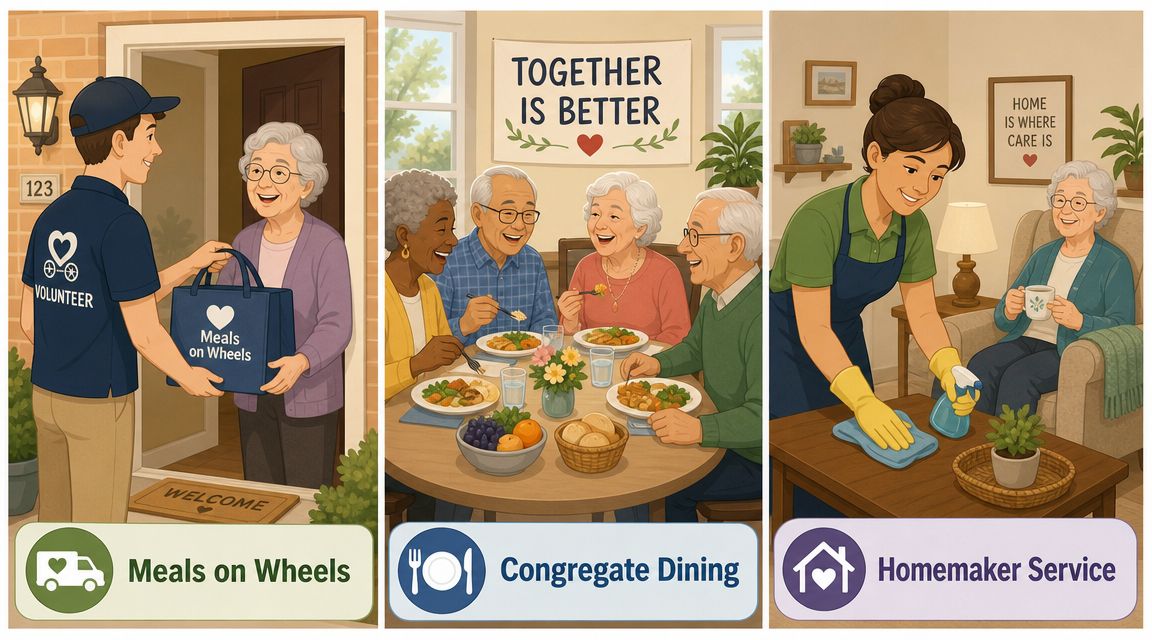
According to NOCOA's public profile on MightyCause, the agency serves more than 2,000 older adults each day, including 435 people receiving home-delivered meals, 345 attending congregate meal sites, and 123 receiving Homemaker Program support. The same profile lists the cost of a meal at $6.95. Those numbers matter because they show these are active, working programs that families use every day.
Home-delivered meals
This program fits a common caregiving problem. The older adult still wants to stay at home, but shopping, standing at the stove, or preparing food safely has become too hard.
A simple way to picture it is this: independence is a chain made of small daily tasks. If meal preparation is the weak link, the whole day starts to wobble. Home-delivered meals support that one weak link so the person can keep living at home more safely.
For example, a father recovering from illness may still be able to dress himself and watch television, but by noon he is too tired to cook. A delivered meal reduces the chance that he skips food, relies on snacks, or leaves a burner on. It also gives the family one less daily emergency to solve.
Congregate dining and senior gathering spaces
Some older adults need food. Others need food plus routine, company, and a reason to leave the house.
Congregate meal sites can help when the problem is not only nutrition but isolation. A mother may still be mobile enough to go out, yet she eats poorly because cooking for one feels like too much trouble. Eating with other people can support appetite, structure, and social connection at the same time.
This distinction helps caregivers ask better questions. If your relative can leave home and participate in a group setting, ask whether a congregate program fits better than home delivery. If your relative cannot get out safely, say that clearly during intake so staff can screen for the service that matches the person's limits.
The Homemaker Program
Families sometimes hear "homemaker" and assume it means ordinary house cleaning. A better way to understand it is basic home support tied to safety and day-to-day functioning.
If laundry is not getting done, the problem is not only dirty clothes. It may also mean cluttered walkways, poor hygiene, and a home that slowly becomes harder to manage. If light cleaning has stopped, the concern may be stamina, balance, pain, memory problems, or all four.
Here is how that usually looks in daily life:
| Daily problem | How homemaker support helps |
|---|---|
| Laundry stacks up and creates clutter | Clothes get washed and pathways stay clearer |
| Floors go unswept | Slip risks may be reduced in high-use areas |
| Trash or basic tidying is neglected | The home becomes easier to manage day to day |
A son may say, "Dad needs someone to clean up a little." Intake staff are often listening for the bigger issue underneath that sentence. Can he keep his home safe enough to remain there?
Small support tasks can protect larger goals, especially staying at home longer.
Information and assistance
Some needs do not fit neatly into a meal or homemaker category. A caregiver may be worried about transportation, housing questions, benefits, or health coverage decisions.
In those cases, information and assistance can work like a front desk for a confusing system. You bring the problem. Staff help sort it into the right next step. If Medicare costs or plan choices are part of the problem, it also helps to review how the State Health Insurance Assistance Program helps with Medicare counseling.
For caregivers, the practical lesson is simple. Do not ask only, "What programs do you have?" Ask, "My aunt is skipping meals," "My uncle cannot keep up with laundry," or "My mother is isolated but can still get out of the house." That kind of description gives staff something they can screen, document, and match to a service.
How to Qualify and Apply for Services
Caregivers usually want straight answers. Is my relative eligible? What paperwork should I gather? How does the process move from the first call to services starting?
Public descriptions make one point clear: the New Orleans Council on Aging is the designated entry point for adults 60+ in Orleans Parish who need meals, transportation, and in-home support, according to its Idealist profile. Public information is less clear about every practical detail families often ask about, such as exact documentation requirements, neighborhood coverage questions, and how quickly help starts.
That means you should treat the first contact as both a request for help and a fact-finding call.
The most likely first screen
For many families, the initial screening starts with two practical questions:
- Is the older adult age 60 or older?
- Does the older adult live in Orleans Parish?
If the answer to both is yes, you likely have a strong reason to call and ask for screening or intake. If your family situation is more complicated, such as disability needs, mixed living arrangements, or uncertain parish residence, ask those questions directly instead of guessing.
What to gather before you call
Because public-facing guidance doesn't fully spell out every document requirement, the safest approach is to prepare a basic caregiver packet. Keep it simple and concrete.
Bring together:
- Identity basics such as the older adult's full name, date of birth, address, and phone number.
- Living situation notes that explain whether they live alone, with family, or in senior housing.
- Need summary with short examples like “can't drive,” “trouble preparing meals,” or “needs help with laundry.”
- Health and contact details including doctor information, emergency contacts, and any major conditions that affect daily functioning.
- Benefit and insurance information if available, especially if you expect questions about coverage or referrals.
If insurance questions come up, caregivers sometimes also benefit from learning how counseling programs work. A plain-language explainer on the State Health Insurance Assistance Program can help you understand that part of the system before or after your call.
A step-by-step application path
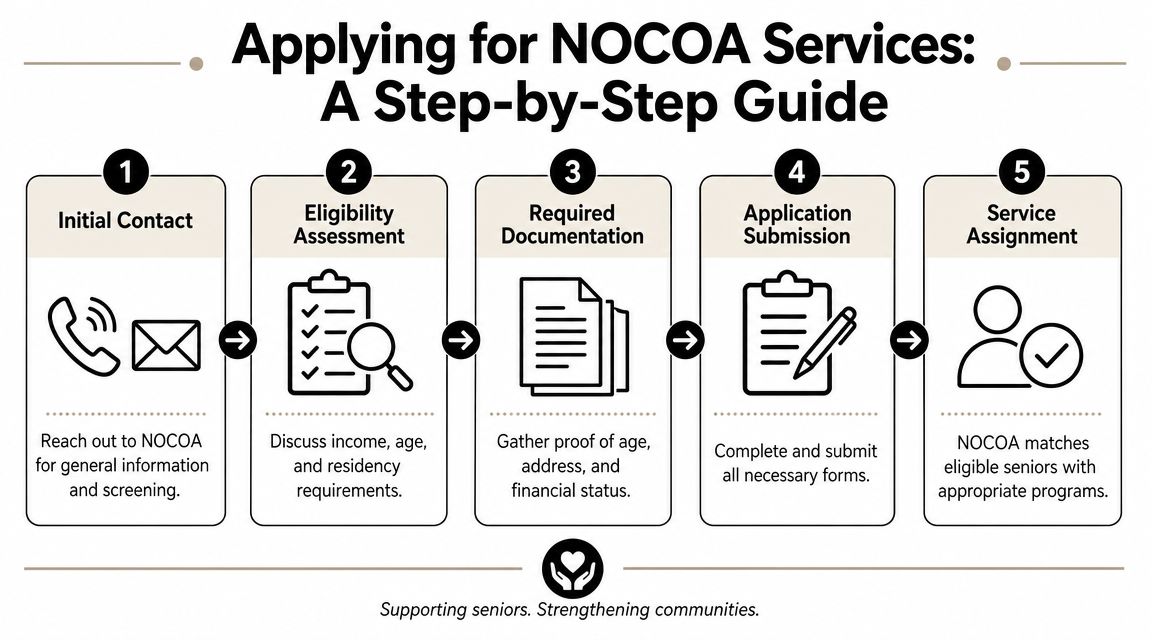
Most families can think about the process like this:
Make the initial call
Explain who needs help, where they live, and what daily problems are showing up.Ask for screening or intake
If the person sounds potentially eligible, ask what the next step is for assessment.Clarify required documents
Don't assume. Ask, “What exactly should I have ready before the assessment?”Write down names and next steps
Record who you spoke with, the date, and what they told you to send or expect.Follow through quickly
If forms or proofs are requested, return them as soon as you can to avoid delays caused by missing information.
Ask one closing question before ending the call: “What would cause this application to stall?” That often reveals the missing piece families don't know to ask about.
Questions worth asking directly
A short list can save you time:
- Are services limited to Orleans Parish residents?
- What proof of age and address do you need?
- Is there a waiting list for the service we need most?
- What should we do if the older adult needs more help than these programs provide?
- Who should I call back if I haven't heard anything?
You do not need to understand the entire eldercare system before reaching out. You only need enough information to begin a clear conversation.
Your First-Call Action Plan for Caregivers
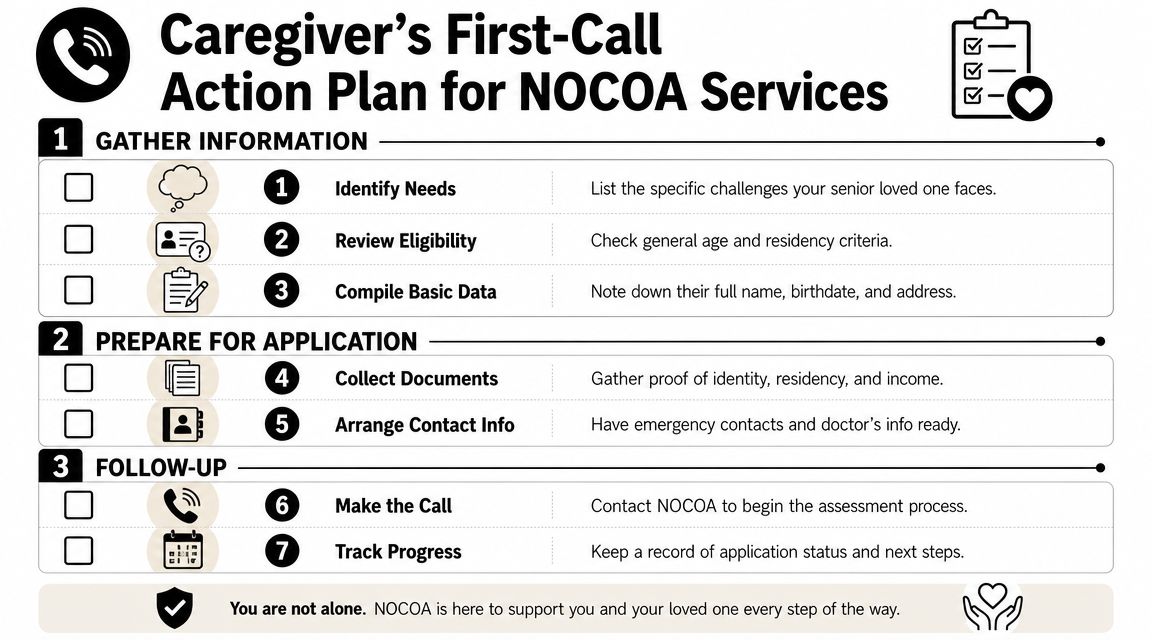
The first phone call goes better when you don't rely on memory. Stress makes people forget names, dates, and the most important questions. A written checklist keeps the call focused and saves you from starting over later.
NOCOA appears to operate at a mid-sized nonprofit scale, with 61 employees and $7.75 million in annual revenue, according to its Cause IQ organizational profile. For a caregiver, that matters because you're contacting a real service hub that can manage intake and follow-through across multiple needs, not just a tiny information desk.
Before you call
Write your notes on paper or in your phone. Don't aim for a perfect summary. Aim for a usable one.
- List the top three problems. Example: missed meals, no transportation, trouble with laundry.
- Confirm the basics. Have the person's full name, birthdate, home address, and best callback number.
- Know your role. Be ready to explain whether you're the daughter, son, niece, neighbor, or another support person.
- Gather key contacts. Keep the primary doctor's name, pharmacy, and an emergency contact nearby.
- Look at the home with fresh eyes. If clutter, narrow walkways, or overloaded rooms are becoming part of the problem, some families find it helpful to review effective senior decluttering strategies before services begin.
During the call
Use short, factual language. Intake staff don't need your whole family history. They need the clearest picture of current need.
Try a script like this:
“I'm calling about my mother. She is over 60, lives in Orleans Parish, and is having trouble preparing meals and getting to appointments. I'd like to know what services or assessment steps may fit her situation.”
Then ask these questions:
- What service should we pursue first?
- What documents do you want before the next step?
- Who will contact us next, and how?
- If my relative's needs get worse before services start, what should we do?
- When should I follow up if I don't hear back?
After the call
This is the part caregivers often skip, then regret.
Create a tiny follow-up record:
| What to track | Example |
|---|---|
| Person you spoke with | Intake staff name |
| Date and time | Tuesday morning |
| Documents requested | Proof of age, address, benefits info |
| Next step | Await callback or submit forms |
| Follow-up date | Date you plan to call again |
If you're coordinating with siblings, send a short update right away. Keep it to facts. “They requested proof of address and a callback number. I'm sending documents today. If we don't hear back by Friday, I'll call again.”
That kind of clear follow-through turns a stressful first call into an organized care process.
Other Essential Senior Resources in New Orleans
You call the Council on Aging, explain what is happening, and get a few names and phone numbers. Then you sit with a notepad and wonder, "Which one do I call first, and what problem is each one supposed to solve?" That is a very common point in the process.
NOCOA is one doorway into help. Families often need a few doorways. A caregiver may need meal support from one place, transportation from another, and legal or dementia guidance from a third. As noted earlier, New Orleans has a large and varied older adult community, so it helps to treat referrals like parts of a care plan, not just extra phone numbers.
When a local referral is not enough
Some situations stretch beyond Orleans Parish. A parent may be planning a move. You may be helping from another city. Or the first local option may not fit your relative's needs.
In those cases, a broader directory can save time. The Elder Care Locator guide for finding aging services by area can help you search by location and compare service options across parishes or states.
Use that tool if:
- Your relative may move soon
- You are coordinating care across more than one city
- You need to compare local services with options elsewhere
- A local agency refers you out and you need to keep going
The types of help families often need next
It helps to sort referrals by the problem they solve. That keeps you from calling five places when only one category really fits.
Transportation help
Ask about this if your relative misses appointments, no longer drives safely, or depends on rides that are inconsistent.Senior centers and social programs
Ask about these if isolation, missed meals, or loss of routine is becoming a problem.Benefits and insurance counseling
Ask for this kind of help if the barrier is paperwork, enrollment confusion, denied coverage, or cost.Dementia and caregiver support
Ask about this when memory loss, wandering, repeated confusion, or caregiver exhaustion is part of daily life.Legal and advance planning support
Ask for referrals here if your family needs help with powers of attorney, benefits disputes, housing problems, or decision-making authority.
One simple rule helps: before you end any call, ask, "If this service is not the best fit, who should I call next?"
How to turn referrals into an action plan
Referrals work like a triage list in an emergency room. The point is to sort by urgency first, not to handle everything at once.
Write each referral into one of these three groups:
- Need now
- Need within the next few weeks
- Keep for later
For many caregivers, the "need now" group includes food, medication access, rides to medical visits, and home safety concerns. The second group may include social programs, legal planning, or caregiver support. The third group is for resources you may not need today but will want ready if the situation changes.
If you are helping siblings or other relatives coordinate care, share that ranked list with them. It gives everyone the same map.
Community support also matters when families hit gaps that no single agency can fill. If you want a broader perspective on why local giving and organized support matter, Stobbe Design on philanthropy's impact offers a useful overview.
How You Can Help Support New Orleans Seniors
Some readers come to this topic as caregivers. Others arrive because they want to help older adults in their community more broadly. Both roles matter.
Support for seniors works best when the community treats it as shared infrastructure, not private family work. That can mean volunteering, donating, or helping a neighbor connect with the right agency before a manageable problem becomes a crisis.
NOCOA's public profile includes ways to support its work, including giving. If you're someone who wants to think more intentionally about community giving, this short piece on Stobbe Design on philanthropy's impact offers a useful perspective on why strategic support matters.
You can also help in smaller, direct ways:
- Share information with a family that doesn't know where to start.
- Offer practical help such as making the first call with an older adult.
- Look into financial support options for seniors by reviewing guides on grants for senior citizens.
- Volunteer locally if meal delivery or senior support opportunities are available through community partners.
The best support is often simple, timely, and consistent.
If you need more practical caregiving tools, worksheets, and plain-language guides, visit Family Caregiving Kit. It's built for families who need to gather information, compare options, and turn a stressful care situation into manageable next steps.