
You may be in the middle of a quiet panic right now. A parent had another fall, forgot medications again, stopped eating well, or called you three times in one afternoon with the same confused question. Home no longer feels fully safe, but the idea of moving them into assisted living in Oakland, CA feels heavy, expensive, and full of unknowns.
The good news is that this decision becomes more manageable when you stop treating it like one giant emotional leap and start treating it like a series of concrete checks. The two issues that matter most are usually the ones families least clearly compare at first: true affordability and whether the care can still work if needs increase. Amenities matter. So does location. But a beautiful lobby won't help if the monthly bill keeps climbing or the community can't handle memory changes six months after move-in.
Start Here A Realistic Needs Assessment
The strongest Oakland search starts with a written care profile. Not a vague sense that your loved one "needs more help." A real document. If you skip this step, you'll tour places based on appearance and price, then discover later that the community can't handle nighttime wandering, insulin support, transfer assistance, or medication complexity.
A practical care profile should cover what the person needs today and what has started to wobble. The wobble matters. Families often wait for a dramatic event, but the pattern usually starts earlier: unpaid bills, missed meals, poor hygiene, increased isolation, confusion with appointments, or caregiver exhaustion.
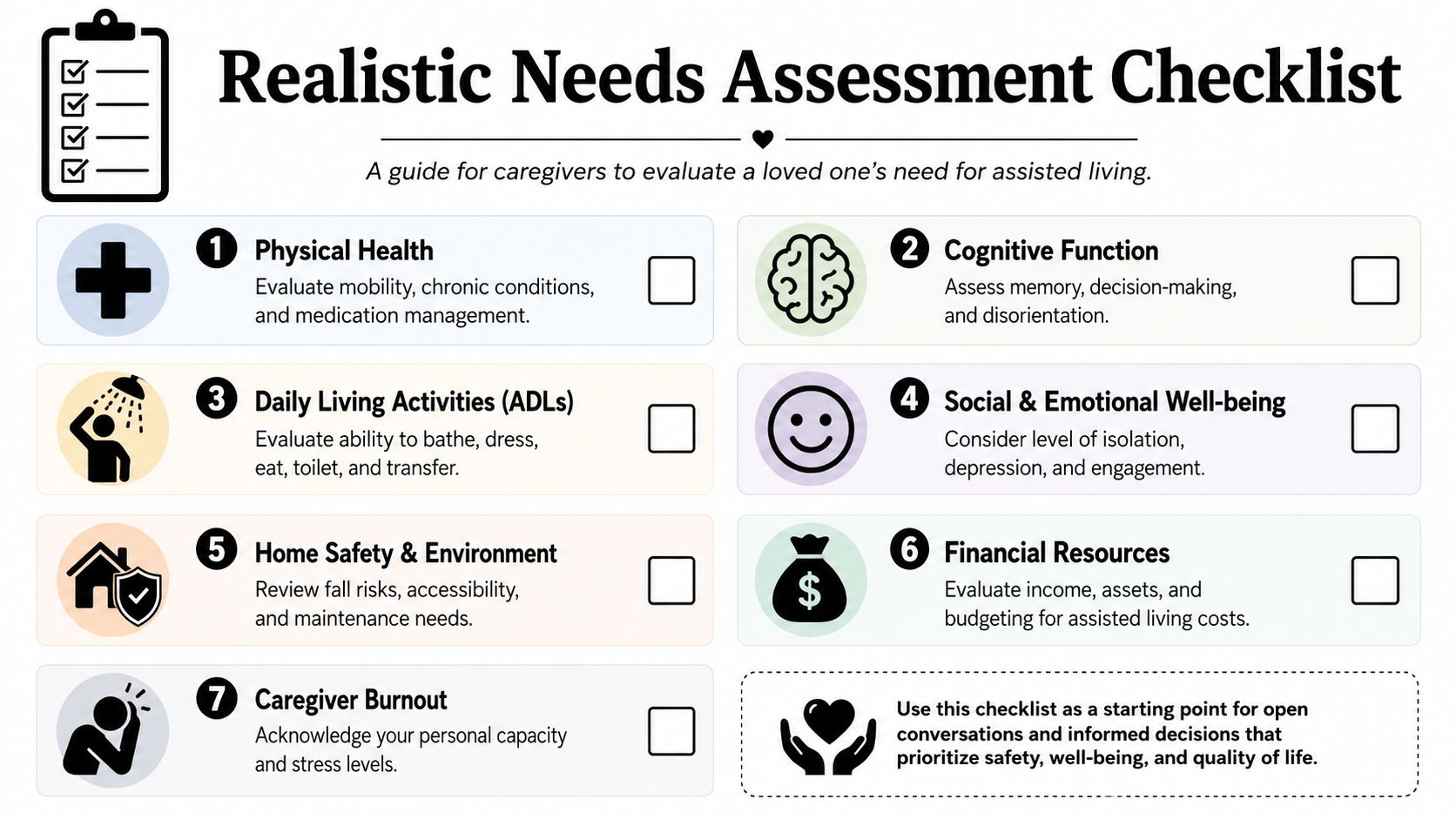
Build the care profile on paper
Use one page per category. Short notes are enough. What matters is accuracy.
- ADLs first: Can they bathe safely, dress without cueing, toilet independently, transfer in and out of bed or a chair, and eat without help? If bathing is now a weekly struggle or dressing takes repeated prompting, write that down.
- Medication reality: List every medication, who fills the pillbox, who reminds them, and what happens when nobody steps in. If doses are missed or doubled, that changes the type of support you need.
- Mobility and fall pattern: Note walkers, canes, fatigue, dizziness, stairs, and bathroom safety. "One recent fall" isn't a detail to minimize. It's often the event that exposes a larger support gap.
- Cognitive function: Track confusion, repetitive questions, poor judgment, financial mistakes, getting lost, agitation, or sleep reversal. You don't need a diagnosis to notice a pattern.
- Social and emotional health: Is the person lonely, withdrawn, suspicious, grieving, or bored? Some people need more than safety. They need structure, companionship, and routine.
- Home environment: Check lighting, clutter, laundry, food spoilage, stairs, and whether the home itself is now too hard to maintain.
- Caregiver strain: If you're handling calls, appointments, meals, medication reminders, and crisis response while also working, your capacity is part of the decision.
Practical rule: If the current arrangement depends on one exhausted person holding everything together, it isn't stable care.
Separate preferences from non-negotiables
Families often blend these together. Keep them separate.
A preference might be private room, pet-friendly policy, garden access, or proximity to a church community. A critical need might be medication management, staff who can cue bathing, secure support for memory problems, wheelchair access, or a building with an elevator.
That distinction keeps tours honest. It also helps siblings stop arguing past each other.
A simple example
If your mother says she wants "independence," translate that into daily realities. Maybe she still chooses her own clothes and enjoys social time, but she no longer manages meals, skips pills, and avoids showering because she's afraid of falling. That profile points toward assisted living with hands-on help, not independent senior housing.
If your father is mostly physically stable but increasingly confused, leaving burners on and getting disoriented at dusk, don't shop only for today's mobility level. Shop for what happens if cognition worsens.
For families still deciding whether added support at home could bridge the gap before a move, resources like Cream Home Care's dedicated elderly support can help you think through what practical day-to-day assistance looks like. Even if you're focused on assisted living, comparing home support tasks against community support tasks sharpens your judgment.
Decoding the Oakland Assisted Living Market
Oakland isn't a bargain market. Families searching for assisted living in Oakland, CA need to go in with realistic expectations about cost and competition, because sticker shock wastes time and pushes people toward bad comparisons.
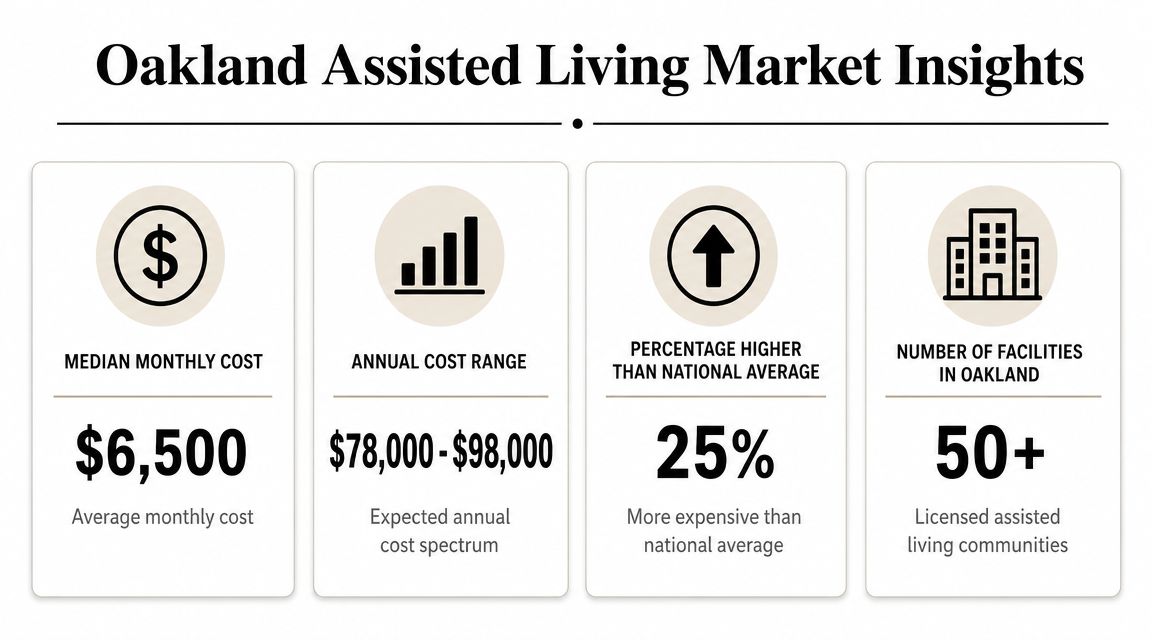
One directory reports an average monthly assisted-living cost in Oakland of $5,500, and the same source lists 26 assisted-living facilities in the city at the time of its snapshot. It also places assisted living between lower-intensity and higher-intensity care options, listing $1,733 for adult day health services and $9,148 for a semiprivate nursing-home room in Oakland, according to SeniorHomes Oakland assisted living cost data.
What the local price picture tells you
That middle position in the care continuum is useful. Assisted living isn't the cheapest option, and it isn't the most medically intensive one. It's a support model for people who need regular help with daily life but don't require nursing-home level care around the clock.
Another Oakland-specific directory view reports assisted living at about $4,932 per month in Oakland, compared with $4,521 statewide and $4,729 nationally. The same page also reports an Oakland 2024 average of $6,035 per month versus $5,808 in 2023, a 3.9% year-over-year increase, based on A Place for Mom's Oakland assisted living market page.
Families don't need to obsess over which single average is "right." The important takeaway is simpler: Oakland is a premium market, and advertised base pricing won't tell you the full story.
Here's a visual summary to keep in mind while comparing communities.
Why brochure prices mislead families
In practice, two communities can both look like they cost roughly the same, while one becomes far more expensive after the care assessment. That's because "starting at" rates usually cover housing and a baseline service package, not every layer of support.
Common additions often include:
- Care-level charges: More help with bathing, dressing, transfers, continence, or escorting can raise the monthly total.
- Medication support: Administration, reminders, or more complex medication handling may be priced separately.
- Move-in and one-time charges: Families often notice these late because they focus on monthly rent first.
- Specialized care transitions: If cognition changes or physical support increases, the rate structure may change quickly.
Compare the effective monthly total, not the starting number on the brochure.
Oakland also includes different community styles. Some are larger campuses with more amenities, dining options, and layered services. Others are smaller residential settings that feel quieter and more home-like. Neither is automatically better. The right fit depends on your loved one's personality, care needs, and tolerance for stimulation, routine, and change.
One Oakland provider, Mercy Retirement and Care Center, says it was established in 1872 and offers assisted living apartment homes starting at $5,720 per month and memory care starting at $9,200 per month, according to AHCA/NCAL assisted living facts and the Mercy Retirement and Care Center listing. That example reflects a broader Oakland reality: many communities sit within a larger continuum-of-care model, which can be a real advantage when needs change.
Before you go further, this short overview gives a useful market snapshot and can help you calibrate expectations before making calls:
Your Search Strategy to Find and Vet Oakland Communities
The fastest way to waste two weekends is to build a list from broad directories and start booking tours. In Oakland, that approach creates confusion because many sites mix licensed assisted living with other senior housing categories, referral partners, or nearby options that don't match what families think they're seeing.
One local directory estimates roughly 88 communities in Oakland, while another Oakland-focused listing references approximately 30 to 40 licensed assisted living facilities in the city. The practical takeaway is clear: online lists can overstate the true assisted-living supply, so caregivers should first filter by California licensing status and actual service type, as noted by Assisted Living Magazine's Oakland market overview.
Build your shortlist in layers
Start with a long list, then narrow hard.
- Filter for licensed assisted living only. If a listing doesn't clearly identify California licensing status, treat it as unverified until you confirm it.
- Remove obvious mismatches. Eliminate communities that don't accept the mobility, cognitive, or supervision needs you identified in your care profile.
- Check care scope before scheduling. Ask whether the community handles medication management, transfer support, incontinence care, memory-related behaviors, or nighttime assistance, depending on your situation.
- Ask about availability last. A quick opening next week can tempt families to rush. Fit matters more than speed.
Vet before you tour
A good pre-tour phone call should save you from bad tours.
Use a script like this:
- "My mother needs help with bathing and medications. Is that within your standard assisted living scope?"
- "How do you assess care level before move-in?"
- "What would make someone inappropriate for your community?"
- "If memory issues progress, can the resident stay?"
- "What fees are separate from rent?"
If the answers are vague, inconsistent, or overly polished, pause. Good operators usually answer operational questions directly.
A community that can't explain its admission criteria clearly is telling you something important before you ever walk in.
Keep the shortlist tight
Three to five finalists is enough for most families. More than that and the details blur together. Less than that and you may feel cornered into one option.
As you narrow, it helps to compare your early list against a practical local roundup such as this guide to assisted living facilities in Oakland, CA. The point isn't to trust any one directory blindly. It's to cross-check names, care types, and which communities are worth a deeper licensing review.
A simple spreadsheet works well here. Track each community's license status, care scope, location, room type, memory care availability, fee structure, and your first impression from the phone call. Families who do this usually feel less scattered and make cleaner decisions later.
Touring with Purpose What to Ask and Red Flags to Watch For
A tour isn't a hospitality event. It's an inspection with human consequences.
I've watched families leave a gorgeous building feeling relieved, only to realize later that they never asked who answers call buttons at night, how medication errors are handled, or what happens after a fall. The lobby did its job. The family didn't yet know what their job was.
Watch the room before you hear the pitch
When you arrive, don't look at the sales packet first. Look at the residents.
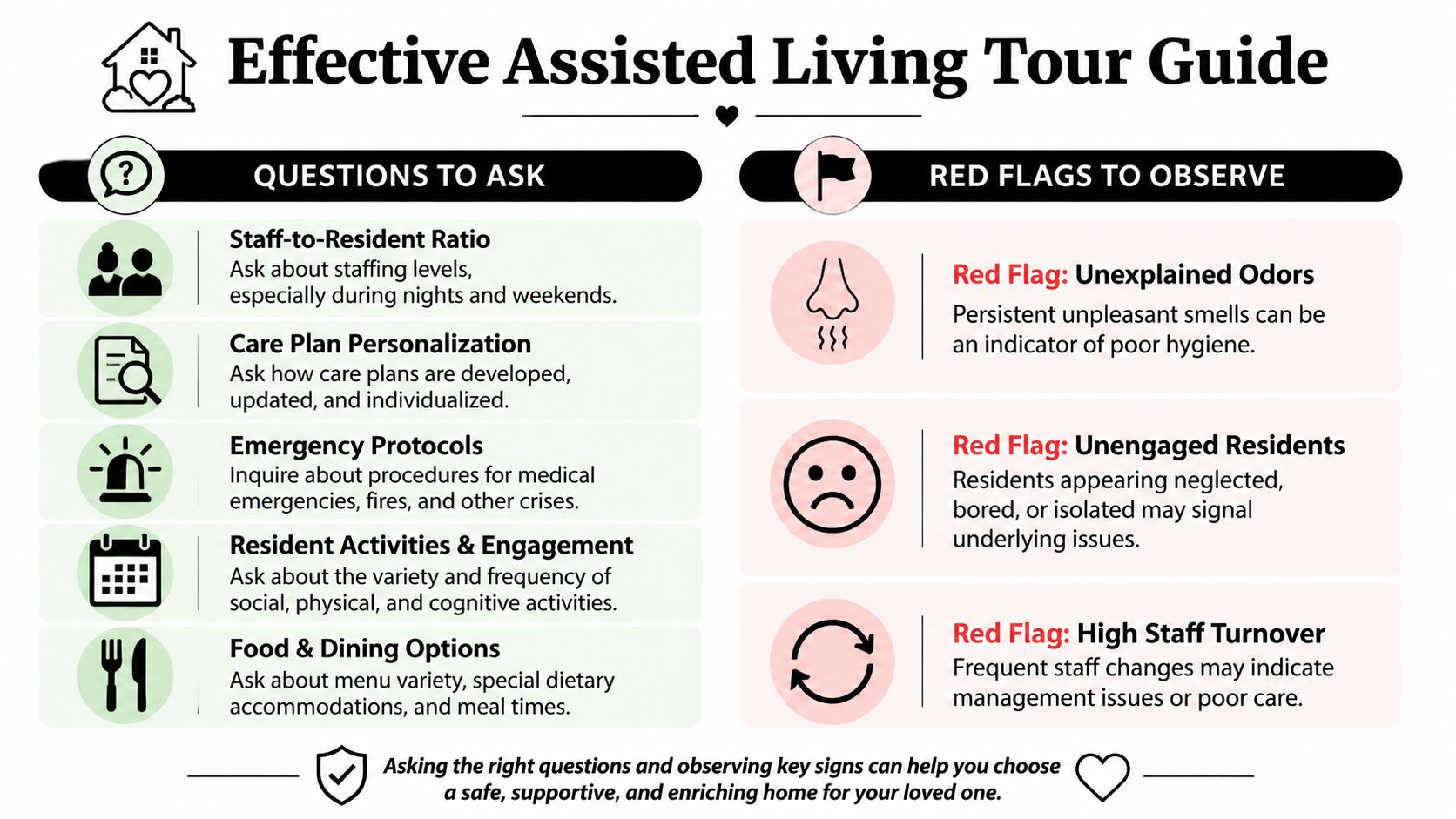
Are people engaged in something that seems age-appropriate and voluntary? Do staff greet residents by name? Does anyone look rushed, ignored, or parked in front of a television with no interaction? A single quiet resident doesn't mean a problem. A pattern of disengagement does.
Also pay attention to the sensory clues:
- Odors: Persistent urine smell or heavy fragrance can indicate hygiene or housekeeping issues.
- Noise: Constant alarms, chaotic shouting, or long unanswered call bells matter.
- Dining room tone: Are meals calm and supported, or does everything feel institutional and hurried?
- Staff behavior: Watch what happens when no one thinks your family is the focus.
Ask questions that reveal operations
One of the most important questions is how the community handles escalating needs. Families often focus on current support, but long-term fit matters more than first impressions. Guidance specific to Oakland families notes that you should ask what triggers reassessment, how transitions are handled, and whether a resident can remain if memory care or more intensive support becomes necessary, according to Faith Based Assisted Living's Oakland guidance.
Use direct questions like these:
- "Walk me through a new resident assessment."
- "Who updates the care plan, and how often?"
- "What happens after a fall?"
- "Who is physically in the building overnight?"
- "How are medications stored, administered, and documented?"
- "What would cause you to ask a resident to move out?"
- "How do you respond when someone refuses bathing or meals?"
Then ask for examples. Not private resident details, but real process descriptions.
Test whether activities are meaningful
Activity calendars can be misleading. A packed sheet of events doesn't tell you whether residents actively participate or whether programming fits different cognitive and physical abilities.
If you want a sharper lens for this part of the tour, Splash Access insights on senior activities offer useful ways to think about engagement beyond bingo and passive entertainment. Bring that mindset into the visit. Ask whether quieter residents, hearing-impaired residents, or people with memory changes are included in ways that still feel dignified.
Good activity programming doesn't just fill time. It gives residents structure, purpose, and chances to connect.
A mini-scenario that often exposes the truth
Suppose a tour director says, "We can age in place." That's promising, but not enough. Follow with, "If my dad starts needing more cueing, has two falls in a month, and begins waking at night confused, what changes?" If the answer becomes slippery, you've learned more than you would've from any brochure.
For a deeper question list you can use during tours and family discussions, this guide on how to choose assisted living can help you turn general impressions into concrete comparison points.
Making the Final Choice and Creating a Financial Plan
This is the stage where many families accidentally compare marketing, not cost. One community looks cheaper because the base rate is lower. Another looks expensive because it includes more in the monthly charge. Unless you convert each option into a true monthly total, you're not making an apples-to-apples decision.
The biggest mistake is focusing on headline pricing instead of true affordability. Oakland communities often have layered cost stacks that include base rent, care-level add-ons, medication management, and move-in fees, so families need to model the all-in cost over time rather than comparing only the starting rate, as emphasized in Front Porch guidance on choosing an Oakland senior living community.
Use a true cost worksheet
Print this table or recreate it in a spreadsheet. Fill it out only after you receive a written fee sheet from each finalist.
| Cost Item | Community A | Community B | Community C |
|---|---|---|---|
| Base monthly rent | |||
| Care level charge | |||
| Medication management | |||
| Incontinence or personal care supplies | |||
| Laundry or housekeeping beyond standard service | |||
| Dining or special diet charges | |||
| Move-in or community fee | |||
| Deposit terms | |||
| Rate change policy | |||
| Memory care transition terms | |||
| Outside caregiver policy | |||
| Estimated all-in monthly total |
What to ask for in writing
Don't rely on verbal reassurance when money is involved.
Ask each community for:
- A full fee schedule: Not just the rent sheet.
- An assessment-based quote: Based on your loved one's actual needs, not a generic starting level.
- Move-in cost summary: Include one-time fees, deposits, and what happens if the move is delayed.
- Rate change rules: Ask when prices are reviewed and how care level changes are billed.
- Discharge or transfer criteria: Financial planning isn't separate from care planning.
The right community isn't the one with the lowest entry price. It's the one your family can sustain without a financial crisis or a forced second move.
Payment planning without wishful thinking
Most assisted living is still a private-pay decision. Some families use proceeds from a home sale, retirement income, family contributions, or long-term care insurance. If your family is exploring insurance, a plain-language primer on LTC insurance costs for retirees can help you understand how to review a policy and what questions to ask before assuming it will cover assisted living expenses.
It also helps to identify one family member who will verify policy benefits, elimination periods, reimbursement rules, and documentation requirements. "We think Mom has a policy" isn't a plan.
For families sorting out coverage questions and policy coordination, this guide to a long-term care insurance specialist can help clarify what kind of professional support may be useful.
Choose with both head and gut
Once the finances are mapped, ask three final questions:
- Can this place meet today's needs well?
- Can it handle a reasonable increase in support without immediate disruption?
- Can the family realistically afford the all-in cost?
If one answer is no, keep looking. The best decision usually feels steady, not flashy.
Oakland Assisted Living Frequently Asked Questions
What is the real difference between assisted living and a nursing home
Assisted living is built for people who need help with daily living, supervision, meals, and medication support, but who don't need the clinical intensity of nursing-home care. Nursing homes are for people with more complex medical needs and higher hands-on care requirements.
If your loved one needs regular help but still benefits from a more residential setting and some independence, assisted living may fit. If they need ongoing skilled nursing or rehab-level support, it may not.
Does Medicare or Medi-Cal pay for assisted living in California
Families should not assume Medicare will cover room and board in assisted living. In most cases, it doesn't function as the primary payer for standard assisted living residency.
Medi-Cal questions are more nuanced and can depend on program eligibility, service type, and setting. Because coverage details can change and individual circumstances matter, confirm directly with the relevant program administrator, benefits counselor, or elder law professional before relying on it in your budget.
What legal documents should be in place before the move
Have the basics organized before move-in day, not after a medical scare.
Priority documents usually include:
- Durable power of attorney: For financial and contract matters.
- Advance healthcare directive: To document medical wishes and decision-makers.
- Medication list and physician contacts: Keep an updated version in both digital and paper form.
- Insurance cards and identification: Needed for admissions paperwork.
- Emergency contact list: Include local family, out-of-area family, and key professionals.
If siblings are involved, decide who is authorized to sign what and who will be the primary contact for the community.
How do we help a parent adjust emotionally to the move
Start by telling the truth kindly. Don't oversell the move as "just like home" if it isn't. Most older adults can sense spin, and it makes trust worse.
Use a few grounded steps:
- Bring familiar items first: Favorite chair, bedding, framed photos, lamp, blanket.
- Keep the first visits calm: Too many relatives at once can be overwhelming.
- Don't ask every day, "Do you like it?" Ask narrower questions such as how lunch was, whether they slept well, or who they met.
- Expect an adjustment period: Sadness, irritability, or second-guessing doesn't always mean the move was wrong.
Sometimes the family needs support with the transition as much as the resident does. That part is normal, too.
If you're trying to turn a stressful eldercare decision into a clear plan, Family Caregiving Kit offers practical guides, worksheets, and decision tools that help families compare options, organize information, and move forward with more confidence.